


Indoor growers managing winter propagation benches or indoor seedling trays often wonder whether legacy tube lighting still deserves space on their shelves. For decades, linear glass tubes illuminated commercial basements, office ceilings, and propagation racks with dependable, soft light. However, as solid-state light-emitting diodes have advanced, many cultivators and homeowners actively ask are fluorescent lights bad compared to modern alternatives. Evaluating these fixtures requires balancing their gentle light output against electrical consumption, operating temperatures, and long-term maintenance hurdles.
While standard fluorescent tubes produce low radiant heat directly beneath the glass, they rely on older gas-discharge physics that consume noticeable wall power relative to the usable photons they deliver. Growers evaluating older high-output T5 fluorescent fixtures frequently notice higher monthly utility bills and gradual spectral degradation across extended photoperiods. In addition, residential plant parents often face concerns regarding physical breakage and disposal regulations. Understanding where these legacy lamps excel and where modern solid-state systems hold the advantage allows indoor cultivators to manage plant canopies and living areas with confidence.


Evaluating the Strengths, Drawbacks, and Safety of Fluorescent Lighting
Fluorescent lighting is not inherently toxic or dangerous when installed, operated, and maintained properly, but modern lighting standards reveal several clear performance limitations. In horticultural and residential environments, these legacy gas-discharge lamps suffer from lower energy efficiency, fixed phosphor spectrums, and fragile glass construction. Modern solid-state light-emitting diodes have largely surpassed fluorescent tubes in photosynthetic output per watt and longevity. Nevertheless, fluorescent fixtures remain functional tools for early seed propagation, gentle clone rooting, and specialized utility tasks when growers take appropriate safety precautions.
Photobiological Performance: PPFD Output and Canopy Penetration
Photosynthetic active radiation describes the waveband between 400 and 700 nanometers that drives plant photosynthesis. Fluorescent tubes produce a broad, diffuse glow that works well when placed inches above tender seedlings or microgreens. However, the photon density drops rapidly as the distance between the tube and the plant canopy increases. Without intense directional photon delivery, light-hungry plants struggle to achieve the daily light integral required for robust vegetative mass.
Photosynthetic photon flux density measures the volume of usable photons hitting a square meter of plant canopy per second. Standard T8, T12, and circular lamps like the Sunlite 41316 FC8T9/CW 8-Inch T9 Round Fluorescent provide modest output that suits shade-tolerant foliage, rooting cuttings, or tabletop terrariums. When growers attempt to flower dense crops or nurture high-light tropical plants under fluorescent light, the center-to-edge falloff leaves outer foliage starved for energy. Plants often respond by stretching with long, weak internodes that collapse under their own weight.
Understanding the indoor plant lighting color spectrum clarifies why fluorescent lamps sometimes deliver disappointing vegetative or blooming results. Fluorescent phosphors produce distinct output spikes rather than a continuous, smooth full-spectrum curve. Cool-white tubes emitting around 4100K provide adequate blue energy to limit early seedling stretch, but they lack the concentrated 660-nanometer deep red wavelengths necessary to trigger robust generative flowering. Consequently, indoor gardeners often find that fluorescent lamps support early propagation but stall mature growth phases.
Energy Efficiency and Operational Heat Generation
Photosynthetic photon efficacy measures how effectively a fixture converts electrical wall power into usable plant photons, expressed in micromoles per joule. Standard linear fluorescent lamps typically deliver between 0.8 and 1.2 micromoles per joule of true electrical draw. In contrast, modern horticultural diodes routinely exceed 2.0 to 2.8 micromoles per joule, delivering more than twice the light for the same power consumption. Over an eighteen-hour vegetative photoperiod, that efficiency gap translates directly into higher electric utility bills.
Electrical consumption represents only half of the thermal equation in an enclosed indoor growing environment. While the surface of a fluorescent glass tube remains cooler to the touch than an older high-pressure sodium bulb, the fixture ballast generates steady heat that radiates into the room. In small grow tents or enclosed propagation closets, multiple four-foot fluorescent fixtures can elevate ambient room temperatures past optimal thresholds. Growers must then run exhaust fans faster, which can complicate humidity and vapor pressure deficit management.
Fluorescent tubes also experience rapid lumen depreciation compared to solid-state alternatives. A standard fluorescent lamp can lose up to twenty percent of its usable photon output within the first ten thousand hours of operation, even though the tube still appears bright to human eyes. Growers who do not measure their canopy PPFD with a dedicated quantum sensor often wonder why their plants grow slower over time. Replacing tubes every twelve to eighteen months restores photon output, but recurring bulb purchases add ongoing maintenance expenses.
Physical Safety, Tube Fragility, and Mercury Content
The presence of elemental mercury vapor inside fluorescent tubes represents the most common safety concern for home gardeners and office workers alike. Mercury is an essential component of the gas-discharge process, exciting phosphors on the interior glass wall to produce visible illumination. When a tube remains intact, the mercury poses zero health risk to indoor occupants or nearby plants. However, accidental breakage releases a small puff of mercury vapor alongside sharp glass shards, requiring immediate room ventilation and careful cleanup procedures.
In active propagation environments, gardening tools, hanging trays, or accidental contact can easily shatter unprotected glass tubes. Using protective sleeves such as FP FLUOROLITEPLASTICS WE’VE GOT YOU COVERED T12 tube guards provides an essential physical barrier that encases the lamp. These polycarbonate shields prevent accidental impacts from shattering the underlying glass across food crops, propagation trays, or living room rugs. If a tube does fracture internally, the durable sleeve contains the glass fragments safely until the fixture can be serviced.
Proper disposal represents another significant responsibility when maintaining fluorescent fixtures. Because fluorescent lamps contain hazardous heavy metals, municipal regulations in many regions prohibit throwing spent tubes into standard household trash bins. Growers must transport exhausted tubes to designated hazardous waste collection points or commercial recycling centers. This disposal requirement contrasts sharply with solid-state LED fixtures, which contain no hazardous gases and present far simpler end-of-life recycling paths.
Ballast failure also introduces minor electrical and fire safety considerations over extended operating lifetimes. Older magnetic ballasts contain internal capacitors and pitch potting that can overheat, produce pungent tar-like odors, or buzz loudly as components age. Modern electronic ballasts run cooler and eliminate audible hum, but they still contain sensitive electrical circuitry subject to eventual component degradation. Regularly inspecting fixture wiring, grounding connections, and socket integrity ensures that older fluorescent ballasts continue running safely without creating electrical hazards.
Visual Comfort, Flicker, and Overhead Glare Mitigation
Fluorescent lighting is widely associated with visual fatigue, headaches, and eye discomfort in residential workspaces, classrooms, and indoor garden corners. Older magnetic ballasts cycle at standard alternating current frequencies, producing a subtle sixty-cycle flicker that human eyes unconsciously register. Even when high-frequency electronic ballasts eliminate visible strobe effects, the intense, unshielded brightness of bare overhead tubes can cause significant glare. This harsh optical environment can make inspecting plant foliage or spending long hours in the room uncomfortable.
Installing magnetic diffuser panels offers a simple and effective method to reduce harsh overhead glare without rewiring ceiling fixtures. Fabric filters such as Wiooffen 2 Pcs Fluorescent Light Covers with 20 magnets or Wiooffen 4 Pcs Fluorescent Light Covers with 40 magnets attach directly to steel drop-ceiling grids to soften bare light output. These covers diffuse direct optical hot spots, producing a tranquil, evenly distributed ambient glow. In rooms where indoor plant shelves share space with home desks, reducing harsh glare dramatically improves daily comfort.
Larger living or learning environments benefit from comprehensive coverage sets to maintain consistent ambient lighting. Outfitting multi-fixture rooms with Wiooffen 6 Pcs Fluorescent Light Covers with 60 magnets or 8 Pcs Fluorescent Light Covers with 64 Magnets ensures uniform diffusion across entire drop ceilings. In creative spaces, decorative options like the ZAQIO 2 Pack Fluorescent Light Cover for Ceiling provide both glare suppression and visual interest. By diffusing harsh downward rays, these covers help occupants enjoy their indoor greenery without enduring aggressive optical contrast.
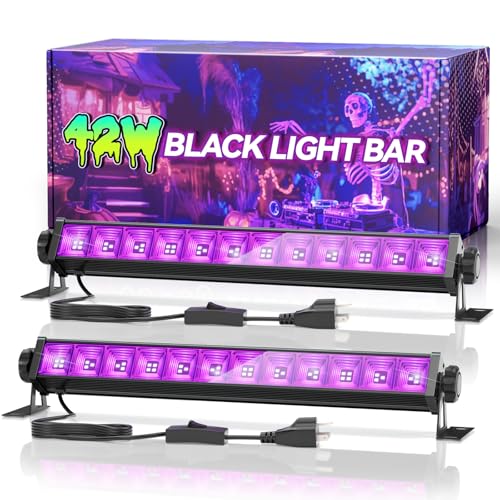
Specialized indoor lighting applications sometimes require targeted wavebands that standard fluorescent tubes cannot deliver efficiently. For example, growers inspecting foliage for fungal outbreaks or pest activity frequently employ narrow-spectrum black lights rather than standard broad-spectrum fixtures. Solid-state options like the 2 Pack 42W LED Black Light Bar emit targeted ultraviolet wavelengths without relying on hazardous mercury vapors or fragile glass tubes. Comparing specialized LED bars against legacy fluorescent tubes highlights how solid-state technology offers superior spectral control and mechanical durability.
When Fluorescent Fixtures Still Make Sense for Indoor Plants
Despite clear efficiency advantages in modern LED panels, fluorescent fixtures maintain a practical role in specific propagation scenarios. Delicate seedling cotyledons and freshly cut vegetative clones possess sensitive photosynthetic machinery that is easily overwhelmed by high-intensity light. The naturally diffuse, moderate PPFD output of fluorescent lamps allows seedlings to establish strong root structures without the risk of photobleaching or leaf curl. Because the tubes produce soft light across their entire length, growers can position them mere inches from foliage safely.
Microgreen production and culinary herb propagation represent another area where fluorescent fixtures remain viable. Fast-growing brassicas, radishes, and leafy greens require relatively modest daily light integral levels during their brief seven to fourteen-day growing cycles. In these short-rotation cropping systems, the capital cost of outfitting multiple nursery shelves with high-end LED arrays may exceed the modest electricity savings. Growers who already own functional fluorescent shop lights can raise healthy, flavorful microgreens without making significant upfront capital investments.
Vintage terrariums, specialized vanity magnifiers, and compact plant nooks also frequently rely on circular fluorescent lamps. Circular fixtures use curved tubes to deliver omnidirectional, 360-degree radial light inside compact enclosures where linear strip lights cannot fit physically. For hobbyists maintaining low-light tropicals like nerve plants, mosses, or miniature ferns in rounded glass displays, an affordable circline replacement provides dependable illumination. As long as growers understand the light limits, these established fixtures continue serving everyday plant keeping reliably.
Upgrading to Solid-State LED Solutions and Integrated Systems
Upgrading existing fluorescent fixtures to solid-state diodes has become an accessible path for growers seeking better efficiency without replacing entire fixtures. LED retrofit tubes are commonly engineered in three primary wiring formats: ballast-compatible Type A, direct-wire ballast-bypass Type B, and dual-mode Type AB configurations. Type A tubes install directly into existing tombstone sockets without electrical modifications, while Type B tubes require disconnecting and bypassing the older ballast entirely. Eliminating the ballast through a Type B retrofit removes a common point of electrical failure and slightly reduces passive power consumption.
Modern horticultural systems increasingly integrate efficient solid-state arrays directly into specialized growing furniture and vertical shelving. Cultivators seeking streamlined propagation frequently explore vertical grow towers with integrated lights to maximize yield across small indoor footprints. These vertical arrangements utilize targeted full-spectrum LEDs positioned close to plant foliage, achieving high daily light integrals with a fraction of the power required by multi-tier fluorescent racks. Integrated solid-state designs also eliminate fragile glass tubes and ballast hum entirely from living spaces.
When evaluating retrofits or new solid-state purchases, growers must verify true electrical wall consumption rather than relying on marketed equivalent ratings. A fixture advertised as replacing a four-lamp T5 fluorescent setup may draw significantly less power while delivering higher usable PPFD directly downward into the canopy. Checking photosynthetic efficacy ratings and uniform footprint maps ensures that the new lighting system provides adequate coverage across all plant containers. Verifying these electrical metrics protects growers from underpowering their canopy or miscalculating circuit electrical loads.
Making the final decision between retaining fluorescent fixtures and upgrading depends on cultivation goals and photoperiod demands. For seasonal spring seed starting spanning just a few weeks each year, existing fluorescent shop lights remain entirely adequate and cost-effective. However, for year-round indoor gardening, flowering crops, or high-DLI tropical collections, transitioning to solid-state fixtures provides superior spectral quality, lower energy costs, and zero mercury disposal concerns. Matching your lighting hardware to your actual plant requirements ensures consistent growth without unnecessary operational expenses.
Fluorescent lights are not inherently bad, but they represent a legacy technology with clear physical and optical limitations. They remain gentle, forgiving options for seedling trays, tissue culture, and low-light foliage, provided they are safely shielded against accidental breakage. For intensive vegetative growth, flowering, and long-term energy efficiency, modern solid-state horticultural lighting delivers far greater photon density and spectral flexibility. By weighing electrical efficiency, canopy PPFD requirements, and physical safety, growers can confidently choose the right lighting solution for their plants and living spaces.



Write Your Review
No reviews yet. Be the first to share your experience!