


Indoor growers and homeowners often wonder whether standard indoor lighting generates ultraviolet radiation that could alter foliage development or raise personal exposure concerns. The direct answer is that regular tubes generate substantial ultraviolet internally, but their phosphor coatings convert nearly all of it into visible illumination. When asking whether do fluorescent bulbs emit uv light, understanding the boundary between safe diffuse white light and unfiltered emissions clarifies how different tube formats behave around delicate canopies. Many cultivators exploring high-output T5 grow light options want to know if stray radiation helps or harms developing tissue.
Standard household and workshop tubes emit negligible, harmless trace amounts of long-wave radiation through their soda-lime glass envelopes. In contrast, specialized horticultural, germicidal, and bug zapper fixtures intentionally bypass phosphors or utilize tailored compounds to emit targeted bands of ultraviolet energy. Identifying the proper spectral output prevents common cultivation mistakes like canopy scorch while ensuring your chosen fixtures align with the best light spectrum for indoor plants. Balancing these lighting mechanisms protects delicate foliage while delivering the exact photon density your indoor growing area requires.




Understanding Ultraviolet Radiation in Fluorescent Lighting Systems
Every standard fluorescent tube generates an intense field of ultraviolet radiation inside its glass envelope through low-pressure mercury vapor gas discharge. Standard commercial and domestic lamps do not broadcast hazardous amounts of ultraviolet light into your room because chemical phosphor powders absorb those short wavelengths. Understanding this conversion process clarifies how regular plant tubes differ from specialized germicidal or blacklight units available on the market today. Knowing what happens inside the lamp gives you complete control over your indoor growing environment.
The Internal Physics of Low-Pressure Mercury Vapor Discharge
Low-pressure mercury vapor discharge forms the physical foundation of all fluorescent lighting technology. Electric current passes between tungsten electrodes at either end of the sealed glass tube, exciting vaporized mercury atoms within an inert noble gas buffer. This excitation prompts electron collisions that emit photons predominantly at two distinct ultraviolet wavelengths: 253.7 nanometers in the shortwave UVC band and 184.9 nanometers in the vacuum ultraviolet range. Because these high-energy photons reside well outside the visible spectrum, the bare internal arc remains invisible to human eyes while packing substantial biological energy. Without an internal conversion mechanism, this intense electrical discharge would pose immediate hazards to living tissue and plant cells.
The efficiency of this gas discharge process makes fluorescent technology practical for indoor illumination. Mercury vapor requires relatively low operating voltages once an ionization pathway establishes itself across the tube. The resulting photon output concentrates almost entirely in the ultraviolet spectrum rather than producing broad white light directly. Standard fixtures rely on secondary materials to bridge the gap between invisible ultraviolet discharge and usable visible illumination.
Phosphor Chemistry and Optical Glass Filtration
Manufactured glass tubes utilize specialized internal coatings to transform destructive internal radiation into usable human and horticultural illumination. Phosphor salts deposited along the inner perimeter of the tube absorb the 253.7 nanometer UVC photons instantly upon excitation. This interaction causes the phosphors to fluoresce, re-emitting the captured energy at longer, visible wavelengths between 400 and 700 nanometers. Standard soda-lime silicate glass serves as a secondary protective barrier because ordinary window-grade glass is naturally opaque to shortwave ultraviolet radiation. High-quality manufacturing ensures that virtually zero UVC radiation escapes through the glass wall of an intact household tube.
Minor traces of ultraviolet energy occasionally escape through standard fluorescent envelopes due to slight variations in phosphor coverage. Sensitive spectroradiometer audits often detect minute emissions of long-wave UVA radiation between 350 and 400 nanometers along with negligible traces of UVB. These trace leakage levels remain comparable to the natural ambient radiation encountered on an overcast afternoon outdoors. Typical indoor houseplants experience no adverse physiological effects from these microscopic leakage levels at standard operating distances.
Specialized Fluorescent Tubes Engineered for Intentional UV Output
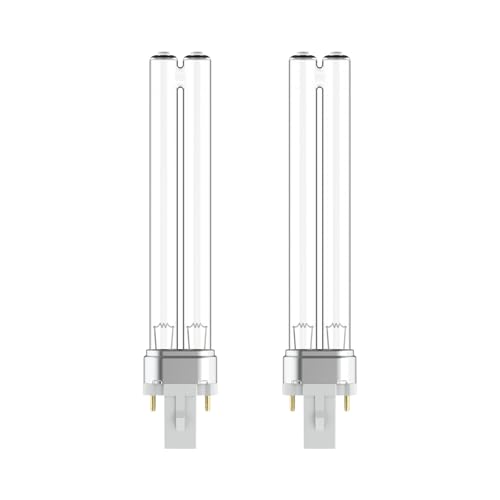
Certain fluorescent fixtures bypass phosphor conversion deliberately to satisfy specific industrial, germicidal, or horticultural demands. Germicidal sanitizing tubes, such as those made by BAIMNOCM or Qualirey, utilize clear fused quartz glass instead of standard soda-lime envelopes. Fused quartz allows raw 253.7 nanometer UVC light to pass directly into the environment without absorption. These fixtures often feature ozone-producing properties when emitting at 184.9 nanometers, making them suitable for HVAC duct sanitization or water clarifier canisters like Tetra pond systems. Because these naked UVC emissions degrade organic compounds rapidly, operators must keep them completely isolated from foliage, pets, and people.
Blacklight lamps represent another category of intentional ultraviolet emitters, utilizing unique phosphors that peak within the UVA waveband. Products like Sunlite spiral CFL blacklights or TITO filament blacklight lamps focus their output near 395 nanometers or 365 nanometers. Rather than illuminating a room for human vision, these units activate fluorescent dyes, assist in pest management, or stimulate specific photochemical reactions. Bug zapper tubes, such as Qualirey T8 replacement bulbs, generate a targeted UVA glow near 365 nanometers to attract flying insects into an electrified grid. These tubes differ substantially from clear germicidal lamps because their emitted photons reside entirely within the gentler, long-wave UVA spectrum.
Photobiological Effects of Ultraviolet Bands on Plant Foliage
Ultraviolet light influences plant biology in distinct ways depending on the specific wavelength band reaching the canopy. The ultraviolet spectrum divides into three distinct categories: UVA from 315 to 400 nanometers, UVB from 280 to 315 nanometers, and UVC from 100 to 280 nanometers. In natural environments, the stratospheric ozone layer filters out all solar UVC and the majority of UVB, leaving terrestrial plants adapted primarily to broad UVA and limited UVB. When indoor growers cultivate crops, managing these subtle wavelength boundaries can trigger positive chemical adaptations or cause severe tissue damage.
Supplemental UVA photons penetrate leaf tissue and stimulate cryptochrome and phototropin photoreceptors within the plant canopy. This gentle stimulation can enhance leaf thickness, regulate stomatal conductance, and encourage tighter internodal spacing during vegetative development. When incorporating dedicated lighting fixtures or indoor vertical grow towers, balanced spectral inputs prevent weak stem elongation and encourage robust lateral branching. Standard broad-spectrum horticultural fluorescent tubes emit just enough passive UVA to promote these natural morphological responses without endangering canopy health.
Moderate UVB exposure triggers defense mechanisms that stimulate secondary metabolite production in herbs, ornamental blooms, and resin-producing botanicals. Plants perceive UVB through a specific photoreceptor protein known as UVR8, which signals the cell to manufacture protective flavonoid pigments and anthocyanins. These compounds function essentially as botanical sunscreen, shielding delicate chloroplasts from excessive photon pressure. However, excessive UVB rapidly crosses the threshold into physiological stress, causing stunted leaf expansion and reduced overall biomass accumulation. Gardeners must carefully balance exposure times when experimenting with specialized UVB fluorescent tubes over sensitive vegetative canopies.
Shortwave UVC radiation produces unequivocally destructive effects on indoor plants, severing DNA bonds and collapsing cellular integrity. Direct exposure to 254 nanometer energy destroys photosynthetic enzymes, induces severe leaf necrosis, and halts vegetative growth within hours. While enclosed UVC water clarifiers or in-duct HVAC lamps protect air and reservoir hygiene safely, bare germicidal lamps must never illuminate an open canopy. Standard fluorescent grow lamps protect your garden by completely blocking these lethal short wavelengths behind phosphor coatings and dense glass.
Differentiating Light Stress from True Ultraviolet Damage
Indoor growers sometimes mistakenly attribute yellowing foliage, chlorosis, or leaf curl under bright fixtures to ultraviolet radiation leakage. In almost every case involving standard fluorescent tubes, the true culprit is excessive photosynthetic photon flux density or thermal heat buildup rather than UV toxicity. High-output T5 fixtures positioned just an inch away from tender canopy tips emit significant radiant heat from their glass surfaces. This localized warmth drives up transpiration rates rapidly, causing leaf margins to curl upward into a canoe shape to conserve moisture. Recognizing the difference between radiant heat stress and radiation burn prevents unnecessary fixture adjustments.
True ultraviolet damage presents as silvery, bleached patches on the upper surface of leaves that do not correspond to heat dry-out patterns. Severe overexposure leads to brittle, crinkled leaf margins and irreversible chlorophyll degradation that stunts new shoot formation. By comparison, general light bleaching from excessive visible photons simply fades vibrant green pigmentation into pale yellow or white. When evaluating delicate crops like herbs or growing vegetables indoors with artificial lighting, adjusting canopy clearance resolves visible bleaching without requiring complicated optical shields. Standard horticultural tubes lack the ultraviolet intensity necessary to cause true radiation necrosis under normal operating conditions.
Distance Rules and Inverse-Square Attenuation
Radiant light intensity decreases dramatically as distance between the fixture and the plant canopy increases, following the physical inverse-square law. Even in fixtures that exhibit minor trace UVA leakage, doubling the distance cuts the photon concentration reaching the leaf surface to one-quarter of its initial value. A standard fluorescent tube suspended twelve to eighteen inches above seedlings delivers virtually zero measurable ultraviolet energy at the leaf plane. This steep drop-off provides a built-in safety buffer against accidental overexposure for both plants and human caretakers.
Maintaining appropriate hanging clearance ensures uniform light distribution while eliminating hot spots across the canopy footprint. Seedlings and soft propagation cuttings thrive when high-output fluorescent strips sit between six and twelve inches above the humidity dome. Established vegetative foliage can tolerate closer positioning near four to six inches, provided ventilation keeps ambient canopy temperatures below eighty degrees Fahrenheit. Because standard fluorescent lamps deliver diffuse, omnidirectional illumination, adequate clearance allows light rays to overlap smoothly across the entire growing bench.
Environmental Safety and Ozone Management with Specialty Tubes
Deploying specialized ultraviolet fluorescent bulbs in cultivation or living areas requires strict safety precautions that standard lighting does not demand. Germicidal tubes operating below 200 nanometers, such as 185 nanometer lamps with ozone generation, dissociate atmospheric oxygen into reactive ozone gas. While ozone acts as a powerful deodorizer and microbial sterilizer, elevated concentrations irritate human respiratory systems and oxidize tender plant leaves. If you operate ozone-producing bulbs in basements, crawlspaces, or utility rooms, adequate ventilation and complete evacuation during active cycles are mandatory requirements.
Ozone-free UVC lamps utilize doped quartz envelopes that block the 184.9 nanometer line while transmitting the 253.7 nanometer germicidal waveband. Although these units eliminate airborne ozone concerns, direct line-of-sight exposure remains hazardous to biological tissue. Skin exposure can cause erythema resembling severe sunburn, while direct eye exposure causes photokeratitis, a painful inflammation of the cornea. When utilizing germicidal lamps for surface sterilization or room hygiene, always power down the fixtures before entering the space or utilize opaque containment shields.
Aging Tubes, Phosphor Degradation, and Spectral Stability
Fluorescent tubes experience gradual changes in spectral distribution as operating hours accumulate over several years. The internal phosphor coating undergoes gradual solarization and chemical fatigue from constant mercury arc bombardments. As phosphors degrade, visible lumen output declines steadily while overall electrical consumption remains largely unchanged. Many growers assume that aging phosphors allow dangerous amounts of internal ultraviolet radiation to leak through the glass envelope.
Photometric evaluations confirm that the underlying soda-lime glass does not become transparent to ultraviolet radiation as it ages. Even when internal phosphors suffer minor degradation and light output dims, the glass envelope continues to block shortwave UVC completely. The primary consequence of an aged tube is simply reduced photosynthetic photon efficiency and shifted color rendering. Replacing standard fluorescent lamps every twelve to eighteen months ensures consistent growth rates without introducing unexpected radiation hazards into your garden.
Practical Verification and Lamp Selection for Indoor Cultivation
Selecting the appropriate fluorescent lamp begins with identifying the primary goal of your indoor cultivation space. For standard seedling starting, microgreen propagation, and vegetative foliage maintenance, standard full-spectrum fluorescent tubes provide balanced illumination with negligible UV risks. Look for lamps clearly marked with standard Kelvin ratings between 3000K and 6500K, which indicate full phosphor coatings engineered for visible light production. These fixtures deliver dependable photosynthetic energy while maintaining completely benign ultraviolet profiles suitable for residential living areas.
If your goal includes stimulating secondary plant metabolites through supplemental ultraviolet radiation, choose fixtures specifically calibrated for botanical use. Specialty horticultural UVA lamps or reptile-grade UVB tubes carry explicit spectral distribution charts and safe operating distance recommendations. Avoid repurposing clear-glass germicidal sanitizing bulbs or unshielded bug zapper tubes for general plant lighting tasks. Selecting fixtures designed specifically for horticultural applications ensures healthy canopy vigor, protects your vision, and creates a productive indoor growing environment.



Write Your Review
No reviews yet. Be the first to share your experience!