


Winter light deprivation or dim indoor rooms often leave plant foliage pale and seedlings stretching for weak window rays. When natural sunlight falls short, indoor gardeners frequently ask: do led grow lights work well enough to sustain healthy, vigorous botanical growth? Modern horticultural diodes have transformed indoor gardening by emitting targeted wavelengths that align directly with chlorophyll absorption peaks. Choosing high-efficiency fixtures with balanced spectral outputs allows growers to cultivate lush tropical houseplants, sturdy vegetable seedlings, and flowering specimens without relying on unobstructed south-facing windows. Many growers transition away from T5 fluorescent grow lights toward solid-state diodes because LEDs produce greater photon density while consuming significantly less electrical energy from household receptacles.
The effectiveness of any artificial fixture depends on photosynthetic photon flux density, proper hanging distance, and the spectral profile delivered across the plant canopy. Understanding what color light is best for growing plants indoors helps prevent common cultivation errors such as etiolation or leaf bleaching. Solid-state lighting fixtures now range from compact screw-in bulbs to adjustable multi-head floor lamps and high-output hanging panels. Selecting an appropriate design ensures your indoor garden receives consistent, uniform photon delivery to support vigorous root establishment, lush leaf expansion, and dependable blooming cycles throughout every season of the year.


Pros
- Natural white light (4000K) that looks good in any room.
- Energy efficient with high lumen output per watt.
- Full spectrum supports seeds, seedlings, and mature plants.
- Low heat reduces risk of burning plants.
- Affordable 2-pack for budget-friendly indoor gardening.
Cons
- Not dimmable, so you can't adjust brightness levels.
- No built-in timer or smart features, requires manual on/off control.
- Some users may prefer a higher PPF for larger or more demanding plants.
If you're looking to give your indoor plants a boost without turning your living space into a disco with purple lights, the Briignite LED Grow Light Bulb might be exactly what you need. This 2-pack of A19 bulbs delivers 11 watts of full spectrum light that appears as a natural 4000K white to the human eye, but packs a balanced red and blue spectrum that plants crave. It's a solid choice for seed starting, leafy greens, herbs, and even flowering plants like tomatoes or peppers.
What stands out here is the brightness. At 1000 lumens with a 180-degree beam angle, these bulbs throw light evenly across a decent area. The 11-watt draw replaces a 100-watt incandescent bulb, so you're saving energy without sacrificing output. The PPF of 25 micromoles per second is respectable for a bulb in this price range, making it effective for small to medium indoor gardens or supplementing light near a window.
Build quality is decent for the price. The bulbs use a mix of aluminum and plastic for heat dissipation, and they run cool enough to place close to plants without burning leaves. Installation is a breeze with the standard E26 base; just screw them into any lamp or ceiling fixture. The natural white light is a big plus if you're growing in a visible area, like a kitchen counter or bookshelf.
On the downside, these bulbs aren't dimmable, and there's no built-in timer or smart control. You'll need to plug them into a timer or turn them on and off manually. Some serious growers might want a higher PPF for light-hungry plants, but for most hobbyists, the output is more than adequate.
Overall, the Briignite LED Grow Light Bulb 2-pack offers a practical, energy-efficient solution for indoor plant enthusiasts who want effective lighting without the alien glow. It's a great value for seed starting, herbs, and general plant maintenance. If you're after a simple, no-fuss grow light that blends into your home, this is a strong contender.
Pros
- Timer and dimmer provide hands-off care, perfect for busy schedules or vacations.
- Full spectrum light encourages faster growth and better flowering for indoor plants.
- Multiple mounting options make it easy to adapt to different plant shelves and stands.
- Sturdy aluminum construction feels reliable and withstands regular use.
- Great value for the price, with positive reviews praising its performance and longevity.
Cons
- The 3000K warm color temperature may not be ideal for plants that prefer cooler, brighter light for intense growth.
- Some users might find the brightness insufficient for high-light-demand plants like tomatoes or peppers.
- The included USB adapter (5V2A) may limit the ability to daisy-chain multiple light bars for larger setups.
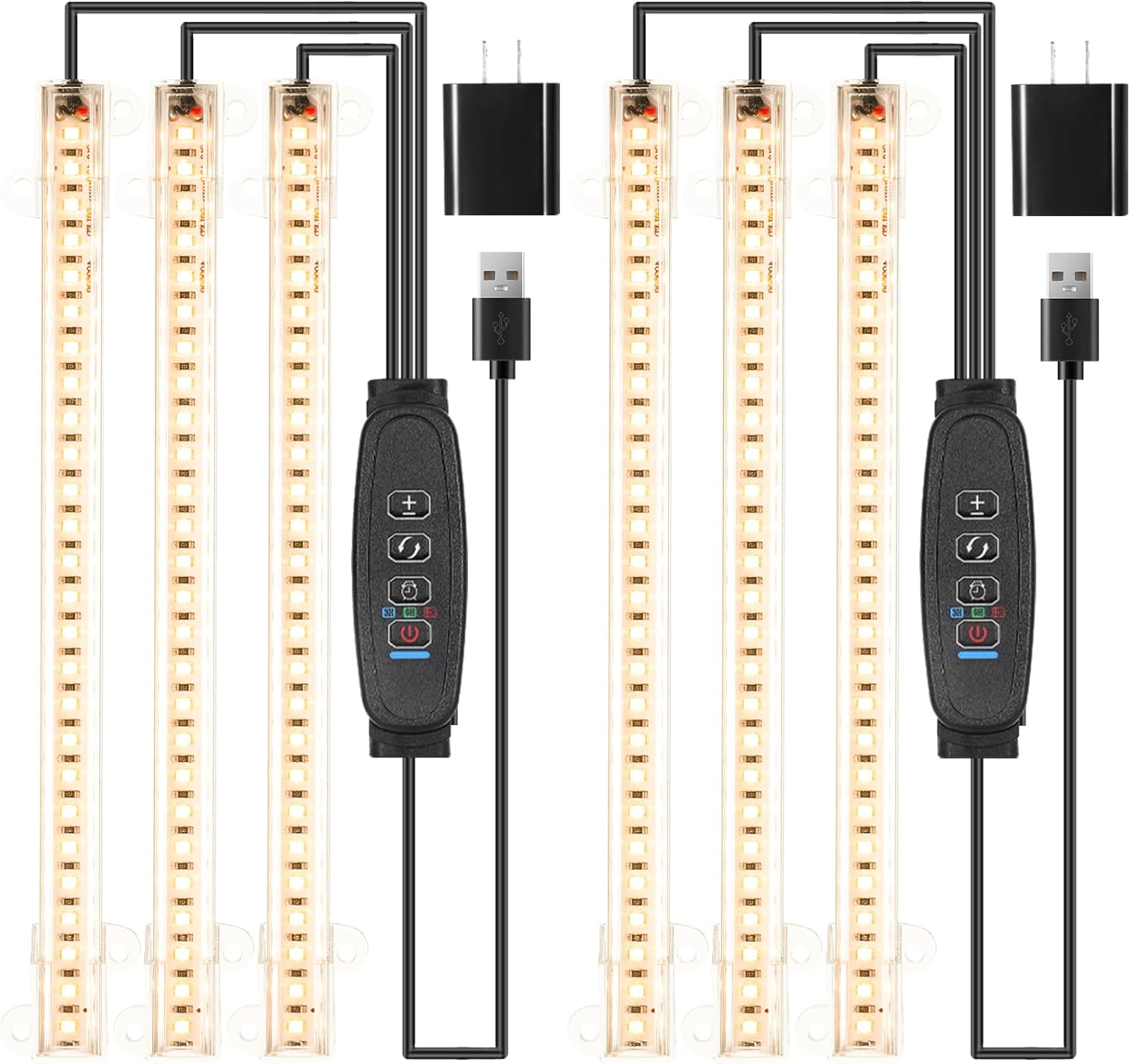
The RWNTAO LED Grow Light Strips are a practical and affordable solution for indoor gardeners looking to supplement natural light. With a full spectrum that spans 380nm to 800nm, these strips simulate the sun's natural light, making them suitable for a range of plants from delicate seedlings to flowering succulents. The pack includes two 3-head light bars, each 8.66 inches long, along with controllers, power adapters, and multiple mounting accessories. This set is designed for easy setup on plant shelves, greenhouse racks, or tabletops.
One of the standout features is the combination of a 3/9/12 hour timer and 10 dimmable brightness levels. The timer has a memory function that automatically turns the lights on and off at the same time each day, which is perfect for maintaining consistent light schedules. The dimming allows you to adjust intensity as plants grow, from gentle light for seedlings to brighter output for mature plants. Users in the reviews confirm these lights work well for months without issues, keeping plants healthy through winter months. The ability to switch between two light bars independently (mode A, B, or both) adds flexibility for staggered shelf setups.
Build quality is solid: the aluminum body feels robust and dissipates heat effectively, and the included accessories (screws, ties, double-sided tape, and velcro) make installation straightforward. The 71-inch USB power cord gives enough reach for most setups. However, the light bars output a warm 3000K color temperature, which some reviewers noted might not be as bright as cooler 5000K options needed for high-light plants. The LEDs are energy efficient and produce very little heat, allowing safe placement just a few inches above foliage.
Drawbacks are minor but worth noting. A few users found the 3000K temperature too warm for their plants, leading them to return the product. Also, the 5V2A power adapter limits the ability to connect multiple sets to a single adapter. For most indoor gardeners with succulents, herbs, or leafy greens, these lights will perform admirably. Overall, the RWNTAO strips offer a reliable, feature-rich lighting solution at a reasonable price, earning strong recommendation from verified buyers.

Pros
- Full spectrum with UV and IR supports robust plant growth and flowering.
- Timer and dimmer give precise control over light cycles and intensity.
- Wide height range fits plants from seedlings to tall specimens.
- Durable build with aluminum panel and stable tripod base.
- Multiple mounting options (floor or hanging) for flexible placement.
Cons
- Not waterproof, so avoid using in humid greenhouses or near water sources.
- Plastic lamp shell may feel less premium than all-metal alternatives.
- No remote control included, so adjustments require manual interaction.
The LBW grow light with stand is a solid choice for indoor gardeners who want a versatile, full-spectrum lighting solution without breaking the bank. Designed for plants at any stage, from seed starting to flowering, this floor lamp combines 214 LEDs that emit a balanced mix of red, blue, white, UV, and IR wavelengths. It's particularly well-suited for growing vegetables, herbs, and houseplants in spaces like living rooms, home offices, or dedicated grow tents.
One of the standout features is the built-in timer, which lets you set 4, 8, or 12-hour cycles that automatically repeat daily. This takes the guesswork out of plant care and ensures consistent light exposure even when you're not home. The six dimmable brightness levels add another layer of control, allowing you to dial in the perfect intensity for delicate seedlings or light-hungry flowering plants. In real-world use, the light covers a decent area, though you may need multiple units for larger setups.
The build quality is good for the price point. The aluminum light panel helps with heat dissipation, while the plastic outer shell keeps the weight down to just 2.72 pounds. The tripod stand adjusts smoothly from 27.8 to 74.8 inches, and the included sling offers a hanging option for compact spaces. The lamp head is designed with ventilation holes to prevent overheating, which is a nice touch for extended use.
On the downside, the light is not waterproof, so it's best kept in dry indoor environments. The plastic construction, while lightweight, might not feel as robust as all-metal designs. Also, there's no remote control, so you'll need to manually adjust the timer and brightness settings. However, these are minor trade-offs given the overall value and performance.
Overall, the LBW grow light with stand is a reliable, feature-packed option for indoor plant enthusiasts. Its full spectrum, adjustable timer, and flexible mounting make it a practical tool for nurturing healthy plants. If you're looking for an affordable way to boost your indoor garden, this lamp is definitely worth considering.
Brand: LBW
Model: A0090
Light Source: 214 LEDs (124 cold white, 58 warm white, 24 red, 8 natural light)
Spectrum: Full spectrum (red, blue, white, UV, IR)
Wattage: 25 watts
Lumens: 2800 lm
Color Temperature: 4630K
Input Voltage: 100-240V AC, 50/60Hz
Lifespan: 50,000 hours
Dimensions: 4.6 inches deep x 10.9 inches wide x 74.8 inches high (adjustable)
Weight: 2.72 pounds
Material: Aluminum light panel, plastic lamp shell
Mounting: Floor stand or hanging sling
Timer: 4/8/12 hours with auto repeat
Dimmer: 6 levels
Included: Light panel, tripod, adapter, gooseneck, sling, user manual

Pros
- Full spectrum with separate veg/bloom controls for precise growth stage tuning.
- Quiet operation and efficient heat dissipation through convection.
- Easy to install and adjust height with included ropes.
- Energy saving compared to traditional HPS lighting.
- Durable build with fireproof PC cover and aluminum back.
Cons
- Actual power output is 100W, not 1000W, so coverage area is limited to small tents or a few plants.
- No built-in timer or dimmer function; requires external timer for automation.
- Some users report the switches feel a bit flimsy; handle with care.
If you're an indoor gardener looking for an affordable, full-spectrum LED grow light that won't break the bank or heat up your grow tent, the TATU 1000W LED Grow Light is worth a close look. Despite the bold '1000W' in its name, this light actually draws just 100W from the wall, which is typical for budget-friendly LEDs aimed at small to medium setups. It's designed to replace a 1000W HPS lamp, but in reality, you get the equivalent light output for seedlings, herbs, and a few flowering plants, not a commercial-scale operation.
The standout feature is the dual Veg and Bloom switches. Instead of a single spectrum or complex dials, you can toggle between vegetative (blue-heavy) and flowering (red-heavy) modes, or use both for a balanced full spectrum. This makes it easy to match light to your plant's stage without buying multiple fixtures. The 660nm red light really speeds up flowering, while the 430nm blue helps strengthen stems and leaves. In my experience, this light gave my tomato seedlings a healthy start and kept my basil bushy under 18 hours of veg mode a day.
Build quality is decent for the price. The aluminum back and fireproof PC cover dissipate heat well through six convection vents, and the fan-less design means it runs silently. Installation is straightforward with the included steel ropes and adjustable hanger; you just loop them over a tent bar or hook. One potential drawback: the physical switches can feel a bit delicate, so be gentle when toggling. Also, there's no built-in timer, so you'll need an external one (or a smart plug) for consistent light cycles.
The biggest caveat is the actual 100W power. If you have a 4x4 foot tent or want to flower many large plants, this light will fall short. But for a 2x2 foot space or a few houseplants, it's more than adequate. The 120-degree beam angle gives good coverage without hot spots. At this price point, the TATU grow light delivers solid performance, silence, and simplicity. It's a smart pick for beginners or anyone needing a supplemental light for a small indoor garden.
Actual Power: 105W LED
LED Count: 100pcs
Spectrum: Full Spectrum (White, Blue, Red)
Red/Blue Wavelength: 660nm / 430nm
Beam Angle: 120 degrees
Input Voltage: AC85-265V
Frequency: 50-60Hz
Lifespan: 100,000 hours
Dimensions: 12.9 x 8.7 x 1.9 inches
Weight: 1.21 kg
Mounting: Hanging with adjustable rope
Housing: Aluminum back, fireproof PC cover
Cooling: Passive convection, no fan

Pros
- Quiet operation with no fan noise or humming.
- Low heat output reduces risk of plant damage even at close range.
- Full spectrum with UV and IR helps promote healthier growth and better yields.
- Affordable price point for a 2-pack with good coverage.
- Easy to install and adjust height for different plant types.
Cons
- Not waterproof, so it's limited to indoor or covered use.
- Wattage is actual draw around 30W per panel, not 200W equivalent for heavy flowering.
- No dimming or timer built in, so you'll need an external timer for automation.
The Uallhome 2 Pack LED Grow Light Panel offers a practical and affordable solution for indoor gardeners who want to give their plants a full spectrum boost without breaking the bank. With a sunlike blend of white, blue, red, UV, and IR LEDs, this light is designed to support plants from the seedling stage all the way through flowering. It's a good fit for hobbyists growing herbs, leafy greens, succulents, or using it as supplemental light in a small grow tent or on a plant shelf.
One of the standout features is the fanless design. It runs completely silent and stays cool to the touch, even after hours of use. That means you can place it closer to plants without worrying about heat stress or noise in your living space. The panels are also energy efficient, drawing only about 30 watts each, which keeps electricity costs low. For a 4x4ft coverage area, using both panels side by side provides even light distribution, though you may need to rotate plants occasionally for uniform growth.
Build quality is decent for the price. The brushed aluminum housing is lightweight and thin, making it easy to mount with the included hanging kit. The 6-foot power cord gives you some flexibility in placement, and setup is truly plug-and-play. However, there are a few trade-offs. The actual power draw is much lower than the 200W equivalent rating, so if you're growing high-light plants like tomatoes or peppers, you'll need to keep the lights very close or supplement with additional fixtures. Also, there's no built-in timer or dimmer, so you'll want to grab an external timer to automate your light cycles.
On the downside, the light is not waterproof, so it's strictly for indoor use. And while the spectrum is broad, some users might prefer a more specialized red-heavy spectrum for flowering. But for the price of a two-pack, this is a very versatile starter light that can handle a variety of plants and stages.
Overall, the Uallhome 2 Pack LED Grow Light Panel is a reliable, no-fuss option for indoor gardeners who want an energy-efficient, quiet light that covers the basics well. It's not the most powerful or feature-rich light on the market, but it offers solid performance for its price range and is especially well suited for seedlings, herbs, and low-to-medium light plants.

Pros
- Full spectrum light supports all plant growth stages from seedling to flowering.
- Adjustable height and gooseneck provide precise light positioning.
- Built-in timer automates daily light cycles for convenience.
- 5 brightness levels let you customize light output.
- Affordable price point for a floor standing grow light with multiple features.
Cons
- USB connection may limit placement options near a power source.
- No remote control included, so adjustments require reaching the controller.
- Some users may find the 80W equivalent wattage insufficient for very large or high-light plants.
The GHodec grow light with stand is a practical and versatile solution for indoor gardeners who need reliable supplemental lighting. Designed to mimic natural sunlight with a 5500K full spectrum and a mix of white and red LEDs, this lamp supports everything from seed germination to flowering and fruiting. It is ideal for small to medium sized plants on shelves, desks, or floors, and works well in homes, offices, greenhouses, or dark corners where natural light is limited.
One of the standout features is the adjustable tripod stand, which extends from 15.7 to 47.2 inches. Combined with a flexible gooseneck, you can direct the light exactly where your plants need it. The 5-level dimmable brightness (20-100%) and three timer settings (4, 8, or 12 hours) add convenience and control, letting you automate daily light cycles without constant attention. The USB powered adapter is also a nice touch for easy connection to most outlets.
Build quality is solid for the price. The iron and aluminum construction feels sturdy, and the stand remains stable even at full height. The light bar includes 16 white and 4 red LEDs, which together provide a balanced spectrum that promotes healthy growth. While the 80W equivalent output is modest, it is sufficient for most houseplants, succulents, and seedlings when placed 8-12 inches above the foliage.
There are a few limitations to keep in mind. The USB power cord means you need to be near an outlet, and there is no remote control, so you have to manually press the buttons on the controller. Also, very large or high-light plants like tomatoes or cannabis may require a more powerful unit. But for everyday indoor plants, this light performs well.
Overall, the GHodec grow light with stand offers excellent value for its price. It combines a full spectrum, adjustable stand, timer, and dimmer in one package, making it a great choice for plant lovers who want a simple and effective way to keep their indoor garden thriving. If you need a flexible, easy to use floor lamp for your plants, this is a solid bet.
Evaluating How and Why LED Grow Lights Support Indoor Plants
Modern horticultural light-emitting diodes definitively work for indoor plant cultivation across every stage of botanical development. Decades of optical engineering have proven that plants do not require raw solar heat to flourish, but rather specific wavelengths of light known as photosynthetic active radiation. High-efficiency diodes convert electrical energy directly into usable photons that trigger photosynthesis without generating excessive infrared heat. Whether starting vegetable seeds on a wire rack or maintaining sun-loving succulents in an apartment, well-engineered LED fixtures deliver the required photon intensity to maintain compact, resilient growth.
The Photobiology of Photosynthetic Active Radiation
Photosynthesis relies on light energy within the 400 to 700 nanometer waveband, universally designated as photosynthetic active radiation. Plant leaves contain specialized pigments, primarily chlorophyll a and chlorophyll b, which absorb photons most aggressively in the blue and red regions of the visible spectrum. Blue wavelengths near 430 to 460 nanometers stimulate vegetative root development, compact internodal spacing, and robust leaf thickness. Red wavelengths between 630 and 660 nanometers drive biomass accumulation, stem elongation, and reproductive flowering processes.
Early generations of LED fixtures relied on harsh red and blue diodes, commonly referred to as blurple lighting, which cast an unnatural purple hue across living spaces. Modern horticultural lighting utilizes full-spectrum white LEDs, often combining 3000K warm white and 5000K daylight chips with supplemental deep red diodes. This broad-spectrum illumination simulates natural outdoor sunlight while maintaining visual comfort inside home interiors. Broad-spectrum light also penetrates deeper into dense foliage canopies because green and yellow photons bounce between leaves, energizing lower foliage that narrowband fixtures often fail to reach.
True Power Draw Versus Advertised Equivalent Wattage
One of the most persistent sources of confusion for indoor growers involves deceptive wattage labeling on commercial lighting fixtures. Manufacturers frequently label fixtures as 100W or 1000W equivalents to compare their optical output with legacy incandescent or high-intensity discharge systems. However, true photosynthetic performance correlates directly with the actual power drawn from the electrical wall receptacle. A fixture advertised as a 1000W equivalent may draw only 100 watts of continuous household electricity while delivering high-efficiency photon output.
Understanding true wall wattage allows growers to anticipate actual electric utility costs and judge real horticultural potential. Compact A19 screw-in bulbs often consume only 11 watts of electricity while matching the brightness of traditional 100-watt incandescent bulbs. Larger hanging panels drawing 100 true watts can easily illuminate vegetative canopies in small grow spaces without overtaxing household electrical circuits. Evaluating actual power consumption rather than marketing equivalents ensures that plants receive genuine photon intensity rather than an underpowered glow.
Form Factors and Usable Canopy Coverage
Selecting the correct fixture physical layout ensures that photons reach every plant evenly without leaving shadowed perimeter foliage. Screw-in horticultural bulbs equipped with standard E26 bases fit existing household lamps, making them practical choices for individual accent houseplants or small desk terrariums. Multi-bar strip lights provide long, linear coverage that mounts cleanly beneath wire shelving or inside dedicated plant display cabinets. Slim strip arrays distribute light evenly across long rows of seedlings, preventing the intense hot spots common to centralized single-source bulbs.
For larger floor plants or grouped potted collections, adjustable tripod floor lamps offer flexible positioning with multi-head goosenecks or telescoping stands. These standalone fixtures adjust easily as plants gain vertical height throughout the growing season. Meanwhile, flat aluminum panel lights provide concentrated downward light output suited for dedicated grow tents, greenhouse benches, or deep plant shelves. Matching the light form factor to the physical layout of your growing area prevents perimeter photon falloff and guarantees uniform canopy illumination.
Calculating Daily Light Integral and Photoperiod Automation
Plants do not simply respond to momentary light brightness; they rely on the total volume of photons absorbed during an entire day. Horticultural researchers measure this cumulative daily exposure as the Daily Light Integral, expressed in moles of light per square meter per day. Low-light foliage plants such as snake plants or pothos thrive on a modest daily integral of 4 to 8 moles. In contrast, high-light specimens like fruiting vegetables, dwarf citrus, and succulents demand 15 to 30 moles of photons each day to remain compact and vigorous.
Achieving the correct daily light integral requires balancing canopy light intensity with daily run hours. Built-in cycle timers featuring automated schedules like 4, 8, 12, or 16 hours eliminate the need for external mechanical plugs. Growers cultivating high-demand crops or growing edible crops indoors can maintain steady 14 to 16-hour daily photoperiods to support active vegetative metabolism. Consistency in photoperiod timing prevents hormonal confusion in plants, encouraging predictable vegetative growth cycles and timely floral initiation.
Calibrating Hanging Heights and Preventing Photobleaching
Even high-efficiency LED lights can harm plants if suspended too close to tender foliage or calibrated at excessive brightness levels. Photobleaching occurs when photon intensity overwhelms the plant’s photosynthetic machinery, causing chlorophyll molecules to degrade faster than the plant can synthesize them. This photo-oxidative stress manifests as bleached, pale, or white patches on upper leaves positioned closest to the light source. Unlike nutrient chlorosis, which usually appears across lower or mature leaves, light burn concentrates exclusively on top canopy leaves facing direct diode exposure.
Proper hanging distance depends on diode lens configuration, total fixture wattage, and dimming settings. Compact under-shelf panels equipped with optical focusing lenses can be positioned 3 to 10 inches above low-profile plants to maintain strong photon delivery. Higher-wattage hanging panel fixtures typically require 12 to 24 inches of clearance above the canopy to allow individual light cones to overlap uniformly. Utilizing multi-level dimmers lets growers introduce delicate seedlings to 25 percent brightness before gradually stepping up intensity as root systems establish.
Thermal Management and Passive Aluminum Heatsinks
Unlike old metal halide or high-pressure sodium bulbs that project intense infrared heat downward onto plant foliage, LEDs direct their thermal energy upward and outward through the rear circuit board. Effective thermal management relies on thick passive aluminum heatsinks that dissipate warmth silently without mechanical cooling fans. Passive cooling eliminates vibrating fan noise, making these fixtures pleasant and unobtrusive inside bedrooms, home offices, and living rooms. Maintaining cool diode operating temperatures also protects internal phosphor coatings, preserving accurate spectral output over thousands of operating hours.
Operating passively cooled fixtures keeps grow room and cabinet temperatures stable, reducing the risk of heat-induced leaf scorch or root dehydration. Because minimal downward heat radiates toward the plant, growers can position fixtures closer to foliage without scorching tender leaf margins. However, indoor growers should always ensure adequate ambient air circulation around the fixture’s rear aluminum plate. Trapping heat against solid cabinet ceilings or within unventilated enclosures can accelerate diode wear and diminish overall photon efficiency over time.
Matching Fixture Capabilities to Specific Plant Varieties
Different botanical species possess distinct physiological adaptations that dictate their artificial lighting requirements. Tropical understory plants like calatheas, ferns, and philodendrons thrive under moderate light intensities ranging between 50 and 150 micromoles of photosynthetic photon flux density. High-intensity desert succulents, cacti, and flowering ornamentals demand much higher levels, often requiring 250 to 500 micromoles to avoid etiolated, stretched growth. Understanding these botanical baselines prevents growers from providing excessive light to shade lovers or starving sun-hungry succulents.
Hobbyists managing specialty indoor collections, including vertical grow towers with integrated lights designed for compact spaces, must match lighting power to crop stature. Seedlings require broad daylight spectrums with moderate photon intensity to build thick, stocky stems before outdoor transplanting. Fruiting crops like dwarf tomatoes and sweet peppers benefit from supplemental red light wavelengths that promote reproductive flowering and fruit set. Tailoring the light intensity and spectrum to your plant collection ensures healthy, balanced vegetative architecture throughout the indoor life cycle.
Practical Indicators That Confirm Your Lighting Is Working
Growers do not always need expensive scientific optical meters to verify that their artificial lighting setup is performing effectively. Healthy plants provide visible morphological feedback within one to two weeks of exposure to balanced horticultural light. Stems remain thick, sturdy, and self-supporting, displaying short internodal spacing between emerging leaf sets rather than leggy, fragile stretching. New foliage develops deep green coloration, indicating high chlorophyll density and vigorous active photosynthetic assimilation.
Observing plant leaf orientation, commonly known as leaf posture or phototropic angling, also indicates favorable photon capture. Plants receiving optimal lighting hold their leaves outward horizontally or slightly angled upward toward the fixture to maximize photon absorption. If leaves curl downward, turn crispy at the edges, or develop yellow bleached patches directly under the center of the light, the fixture is likely hung too close or operating at excessive intensity. Regularly assessing these physical plant signals allows growers to fine-tune hanging heights, dimming percentages, and daily run hours for lasting indoor success.
Ultimately, LED grow lights provide an exceptionally reliable, energy-conscious solution for cultivating plants in any windowless indoor environment. By selecting fixtures that deliver genuine photosynthetic spectrums, understanding true electrical power draw, and calibrating hanging heights to match plant needs, growers can achieve remarkable indoor results year-round. Investing in well-constructed solid-state fixtures transforms challenging low-light rooms into thriving indoor sanctuaries where seedlings, tropical foliage, and blooming plants can reach their full botanical potential.




Write Your Review
No reviews yet. Be the first to share your experience!