

Indoor growers often celebrate vigorous growth under modern horticultural LEDs, yet unchecked light intensity creates hidden physiological risks. When photon delivery exceeds what plant cells can process, delicate foliage begins to suffer irreversible cellular breakdown. Many hobbyists ask whether can grow lights burn plants, especially when transitioning from dim window light to concentrated diode arrays or high-output bulbs. The short answer is yes, though the injury typically stems from either excessive photon flux density causing photo-oxidative stress or raw radiant heat scorching the leaf tissue. Understanding how light interacts with chlorophyll helps indoor gardeners maximize vegetative growth without pushing delicate leaves past their physiological breaking point.
Different plant species exhibit wildly diverse tolerances for light intensity, meaning a hanging distance that nurtures a sun-hungry succulent can quickly destroy a shade-loving tropical aroid. Dialing in fixture height, dimmer levels, and daily photoperiods prevents severe canopy bleaching while maintaining lush, green foliage. Evaluating your fixture’s actual photosynthetic output alongside proper spectral quality and color selection ensures balanced growth without burning tender shoots. By recognizing early distress signals and establishing proper clearance distances, you can safeguard your indoor canopy and maintain optimal plant vitality year-round.
Top Products

Pros
- Versatile full spectrum with 3 color options and 5 brightness levels.
- Convenient automatic timer for hands-off daily care.
- Adjustable height accommodates a range of plant sizes.
- Sturdy base and metal stake for stable placement.
- Affordable price for a feature-rich growing lamp.
Cons
- Requires the flower pot to press down on the stand for stability on flat surfaces.
- Not waterproof, so keep away from wet areas.
- Brightness may be too low for large or light-hungry plants.
If you are looking for an easy way to keep small indoor plants thriving, the LBW Grow Light is a solid choice. This compact LED lamp delivers a full spectrum of light (380-800nm) that mimics natural sunlight, helping plants like succulents, herbs, and orchids grow strong even in low-light rooms. It is especially suited for beginners or anyone who wants a low-maintenance lighting setup without breaking the bank.
One of the standout features is the adjustable timer. You can set it to run for 6, 8, 12, or 16 hours, and it will automatically turn on and off at the same time each day. This is a real convenience if you travel or just forget to turn lights on manually. Pair that with five brightness levels and three color modes (white, warm, and full spectrum), and you get a lot of control over how your plants get their light. The colors also make the lamp pleasant to have in a living space, not harsh or purely functional.
Design-wise, the lamp feels sturdy for its size. The metal pole telescopes from 7.8 to 26 inches, so you can raise or lower it as your plants grow. The base is wide (almost 2 inches) and includes a metal stake that you can stick directly into a pot. But note: on a flat surface, the base needs the weight of the flower pot to keep the stand stable. The 78-inch power cord is generous, letting you position it almost anywhere. Assembly is straightforward and takes just a few minutes.
On the downside, the light is not waterproof, so it is strictly for indoor use. Also, with a 7-watt output, it is best for smaller plants. If you have large leafy plants or a full shelf of greenery, you might need a more powerful unit. The brightness levels are dimmer than some pricier models, but for typical houseplants, the lowest setting (20%) still provides enough light energy for basic growth.
Overall, the LBW Grow Light hits a sweet spot for price, features, and performance. It is a practical, affordable solution for nurturing small indoor plants and works well as a decorative accent. If you want fuss-free lighting with smart timer functions, this lamp is worth considering.

Pros
- Natural white light blends with home decor.
- Energy efficient with long lifespan.
- Effective for seedlings, herbs, and low-light houseplants.
- Low heat reduces risk of plant damage.
- Simple screw-in installation into standard lamps.
Cons
- Bulb size (BR30) may not fit small or compact lamp fixtures.
- Some users reported one bulb arriving defective out of the two-pack.
- No built-in timer requires an external timer for automated schedules.
The GE BR30 LED Grow Light Bulbs (2-Pack) are a practical solution for indoor gardeners who want to boost plant growth without cluttering their space with bulky fixtures or harsh purple lighting. Designed for seeds, greens, and flowering plants, these bulbs deliver a balanced red-blue spectrum that mimics natural sunlight, helping plants photosynthesize effectively. Whether you're starting seedlings in a basement or keeping herbs alive on a kitchen counter, this set offers a simple upgrade.
Standout features include a natural white light temperature that makes these bulbs look like standard LEDs, not the typical pink or purple glow many grow lights emit. This means you can place them in living areas without an eyesore. The 9-watt power consumption keeps electricity costs low, while the 25,000-hour rated lifespan means years of reliable use. Real-world performance from verified buyers shows noticeable improvements in plant health, with many reporting stronger growth, greener leaves, and even flowering in previously dim corners.
Design-wise, the BR30 shape is slightly larger than a standard A19 bulb, so you'll need a lamp that can accommodate it. The build feels solid, though a handful of users noted one bulb in the pack arrived nonfunctional, suggesting occasional quality control issues. That said, the majority of reviews (over 19,000 with a 4.6-star average) highlight consistent results and satisfaction. The low heat output is a genuine plus, letting you place the bulb close to plants without burning foliage.
Drawbacks are minor but worth noting: the bulbs lack a built-in timer, so you'll need an external outlet timer for consistent photoperiods. Also, because the PPF is around 16 micromoles per second, these are best suited for low to medium light plants; high-light crops like tomatoes may require supplemental lighting or closer placement. The package includes two bulbs, offering good value for small setups.
Overall, the GE BR30 grow lights deliver what they promise: effective, discreet, and energy-efficient lighting for indoor plants. If you have a standard lamp socket and need to give your plants a boost without sacrificing aesthetics, this set is a reliable choice. Just be prepared to use an external timer and double-check each bulb upon arrival.

Pros
- Full-spectrum light mimics natural sunlight for better photosynthesis
- Auto timer simplifies daily light schedules for seedlings and flowers
- Dimmable from 10% to 100% to suit different plant stages
- Flexible gooseneck and clip make placement easy on shelves or desks
- Energy-efficient 10W LED uses little power for long-term use
Cons
- Timer may drift slightly; needs weekly reset for accuracy
- Not waterproof - avoid moisture when watering plants
- Best for small to medium indoor plants; less effective for large setups
The bseah Grow Light is a practical full-spectrum LED lamp designed for indoor plants, from seedlings to flowering houseplants. It combines yellow and white light wavelengths (640-660nm and 460-470nm) to support photosynthesis, growth, and blooming. With 40 lamp chips in a compact 10W unit, it delivers uniform brightness without overheating.
Its standout feature is the auto timer: set it once for 3, 9, or 12 hours, and the light turns on and off at the same time daily. This works well for consistent schedules, though the timer may drift slightly over weeks - a quick power reset fixes it. The 10 dimmable levels let you adjust brightness from 50% to 100% based on your plant's growth stage.
The build is solid: a metal gooseneck holds its position, and the clip mounts on edges up to 3 inches thick. It's lightweight and easy to reposition on shelves or desks. The 5V USB adapter keeps it safe for indoor use, but it's not water-resistant, so keep it dry during watering.
For the price, it's a reliable entry-level option for small indoor gardens. Some users note the timer isn't perfectly precise, but it's fine for most setups. Overall, it's a good choice for beginners or anyone needing a simple, adjustable grow light.

Pros
- Looks like a normal white light bulb, fits any room aesthetically.
- Energy-efficient compared to traditional grow lights or incandescent bulbs.
- Long lifespan (50,000 hours) means years of reliable use.
- Easy to install in standard E26 sockets; no extra hardware required.
- Full spectrum works for a wide variety of indoor plants at every stage.
Cons
- Not dimmable, so you cannot adjust brightness for different plants.
- 12 watts may be underpowered for larger plants or multi-tier setups.
- Only two bulbs per pack; you might need more for a sizeable garden.
The Briignite BR30 LED grow light bulbs are a solid choice for indoor gardeners who want effective plant lighting without the harsh purple glow. This 2-pack delivers a full spectrum that mimics natural sunlight, but the light appears as a warm white (3500K) that blends naturally into any room. They are ideal for starting seedlings, keeping herbs happy on a kitchen counter, or supplementing light for leafy greens and even small fruiting plants like peppers and tomatoes.
What sets these bulbs apart is their balance of performance and convenience. Each bulb draws only 12 watts but pumps out 1000 lumens with a wide 180-degree beam angle. The PPF (photosynthetic photon flux) is rated at 25 micromoles per second, which is competitive for this wattage. That means your plants get usable light without a huge energy bill. The 50,000-hour lifespan also means you won't be swapping bulbs every season.
Design-wise, these are standard BR30 reflector bulbs with an aluminum and plastic housing for heat dissipation. They feel robust and stay cool to the touch even after hours of use. The E26 base fits most standard sockets, so installation is as simple as screwing them into a lamp or ceiling fixture. No extra drivers or wiring needed.
On the downside, these bulbs are not dimmable. If you need variable light intensity for different plant species or growth stages, you'd be better off with a dimmable option. Also, at 12 watts each, they are better suited for small to medium setups rather than large grow tents. The 2-pack is a good start, but you may need more bulbs for a substantial garden.
Overall, for the price, these Briignite grow bulbs offer a practical, attractive way to boost indoor plant growth. They perform well, look good, and are energy-smart. If you appreciate subtle, effective lighting and want to avoid the purple glow, this set is worth considering.

Pros
- Full spectrum plus targeted red/blue/yellow LEDs optimize photosynthesis and flowering
- Timer and dimming features automate light schedules and prevent light stress
- Durable metal and PVC construction with a secure clip that holds firmly
- Adjustable arms let you direct light exactly where needed
- Backed by over 12,000 positive reviews and a 4.5 star rating
Cons
- Not waterproof, so keep away from humid areas or use a cover
- Only one unit per purchase, may need multiple for larger setups
- Plastic components may feel less premium than all-metal alternatives
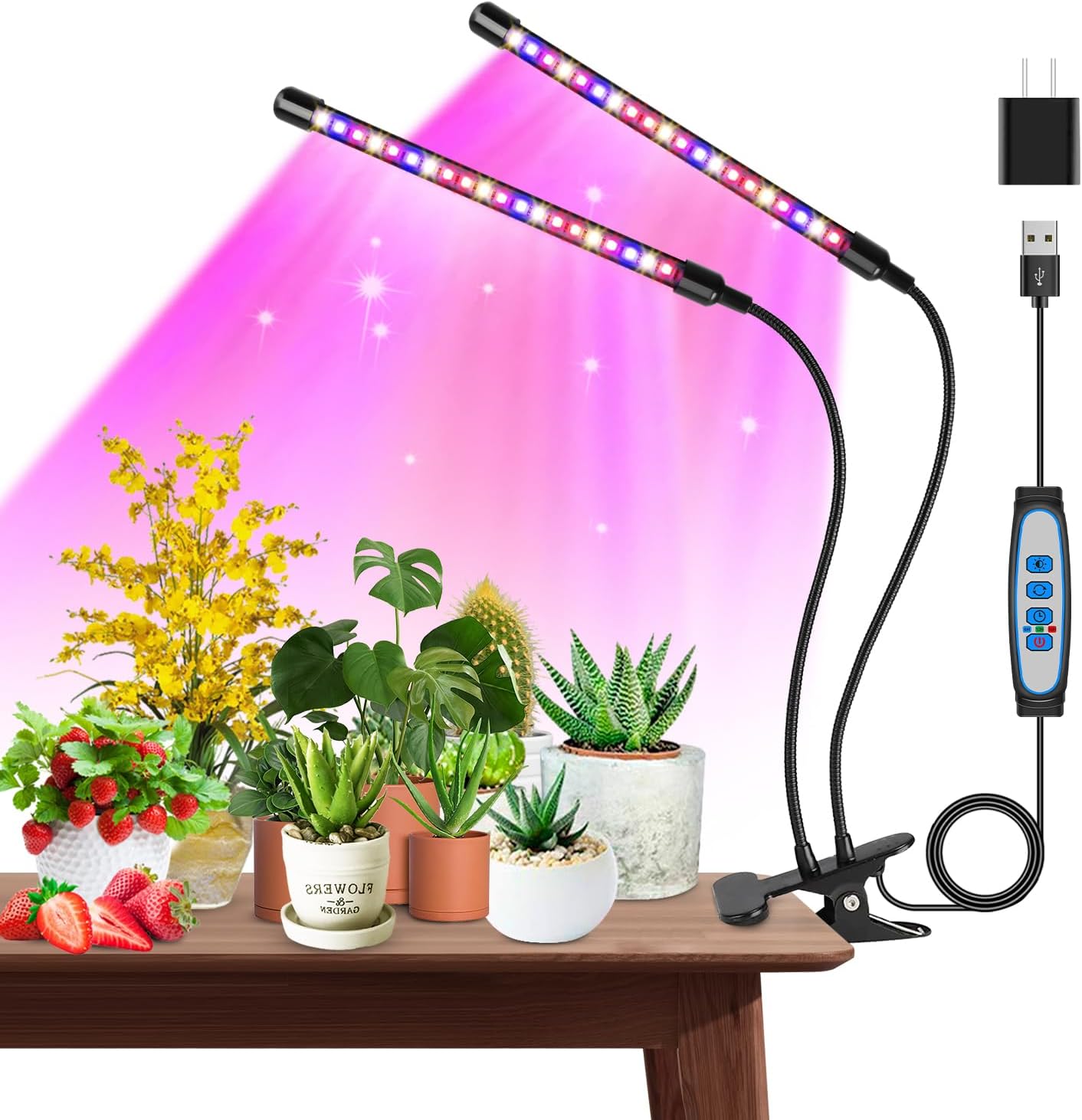
The LEOTER Upgraded 4 Head Grow Light is a compact yet powerful LED fixture designed for indoor plants. It packs 80 individual LEDs across four adjustable heads, combining red (660nm), blue (460nm), yellow (380-860nm), and white light to mimic natural sunlight. This makes it a solid choice for hobbyists growing succulents, herbs, leafy greens, or even flowering plants on a windowsill or in a small grow tent.
What sets this light apart is its flexibility. The 3/9/12 hour timer and 10 dimmable levels let you automate light cycles and adjust intensity without moving the fixture. The three switch modes let you use red+blue for vegetative growth, yellow for a warmer glow, or all lights together for full spectrum coverage. During real-world use, the gooseneck arms hold their position well and the clip grips tightly to surfaces up to three inches thick, so you can aim light precisely at your plants.
Build quality is mostly solid: the metal clip and arms feel sturdy, though the plastic head casings are lightweight. The 5V adapter is efficient and runs cool. One minor drawback is that the unit is not waterproof, so it is best used in dry indoor environments. Also, for larger collections you might need multiple units, as the coverage area is best for a single shelf or small table. At this price point, the features and performance are impressive, especially given the high customer rating.
Overall, the LEOTER grow light offers a great balance of control, spectrum, and value. It handles most common indoor plants well, and the timer and dimming functions make it easy to give your greens consistent care. If you are looking for an affordable, adjustable LED light for a small indoor garden, this is a strong contender.

Pros
- Full spectrum with dedicated red, blue, and yellow LEDs for balanced plant growth.
- Convenient auto timer with cycle memory – no daily manual reset needed.
- 10 brightness levels allow fine-tuning for light-sensitive or light-hungry plants.
- Multiple mounting options and included hardware make setup flexible and easy.
- Excellent value for money given the number of LEDs and features.
Cons
- Does not automatically resume after a power outage – you must press the on button again.
- Controller symbols can be hard to read in low light, making mode selection tricky.
- Timer options limited to 3, 9, and 12 hours; some users may prefer 6-hour cycles.
The RWNTAO Four Strip Growing Lamp is a solid all-in-one solution for indoor plant enthusiasts who need consistent, full-spectrum light without breaking the bank. Designed with 192 LEDs across four 13-inch strips (16 red, 16 blue, and 16 yellow per strip), it covers wavelengths from 380nm to 800nm to mimic natural sunlight. Whether you're nurturing succulents, starting seedlings, or boosting flowering houseplants, this light aims to support every stage of growth. Its $20.99 price tag and high customer rating (4.5 out of 5 stars from over a thousand reviews) make it a popular choice among hobbyists and greenhouse owners.
The standout feature is the combination of a programmable auto timer (3, 9, or 12 hours) and 10 dimmable brightness levels. You can set a schedule, and the lamp remembers it day after day – a real convenience for busy people or those on vacation. The three spectral modes (yellow alone, red+blue, or full-spectrum) let you tailor the light to your plants' needs. Real-world performance is impressive: many reviewers report healthier growth, stronger stems, and even blooming in winter. The lights are bright enough to cover a large shelf area, and the ability to dim them down to a soft glow makes them functional as a gentle night light too.
Build quality is better than expected at this price. The aluminum backing on each strip dissipates heat efficiently, so the lights stay cool even after hours of use. Installation is a breeze with four included methods: screws, double-sided tape, magnets, or zip ties. Several users mention using the tape to mount strips under wooden shelves, and it holds firmly. The power adapter and inline controller are straightforward, though a handful of reviewers note the symbols on the controller are hard to decipher in low light. A minor quibble, but something to keep in mind.
There are a couple of honest drawbacks. The most frequently mentioned is that after a power interruption, the lamp does not automatically turn back on – you have to manually press the on button. If you live in an area with frequent outages, that could be a hassle. Also, the timer only offers three fixed intervals (3, 9, and 12 hours). Some competing lights provide a 6-hour option, which might be more suited to certain plant species. The lamp also doesn't include a remote or app control, so you'll be adjusting settings directly on the controller.
Overall, the RWNTAO Four Strip Growing Lamp delivers exactly what most indoor gardeners need: effective full-spectrum light, flexible controls, and easy setup at a very reasonable price. It's not perfect – the power-loss behavior and limited timer choices are real issues – but for the vast majority of users, these are minor trade-offs. If you want a reliable, feature-packed grow light for a small to medium setup, this is a strong contender. Just be aware of its quirks before you buy.

Pros
- Full spectrum with UV and IR supports robust plant growth and flowering.
- Timer and dimmer give precise control over light cycles and intensity.
- Wide height range fits plants from seedlings to tall specimens.
- Durable build with aluminum panel and stable tripod base.
- Multiple mounting options (floor or hanging) for flexible placement.
Cons
- Not waterproof, so avoid using in humid greenhouses or near water sources.
- Plastic lamp shell may feel less premium than all-metal alternatives.
- No remote control included, so adjustments require manual interaction.
The LBW grow light with stand is a solid choice for indoor gardeners who want a versatile, full-spectrum lighting solution without breaking the bank. Designed for plants at any stage, from seed starting to flowering, this floor lamp combines 214 LEDs that emit a balanced mix of red, blue, white, UV, and IR wavelengths. It's particularly well-suited for growing vegetables, herbs, and houseplants in spaces like living rooms, home offices, or dedicated grow tents.
One of the standout features is the built-in timer, which lets you set 4, 8, or 12-hour cycles that automatically repeat daily. This takes the guesswork out of plant care and ensures consistent light exposure even when you're not home. The six dimmable brightness levels add another layer of control, allowing you to dial in the perfect intensity for delicate seedlings or light-hungry flowering plants. In real-world use, the light covers a decent area, though you may need multiple units for larger setups.
The build quality is good for the price point. The aluminum light panel helps with heat dissipation, while the plastic outer shell keeps the weight down to just 2.72 pounds. The tripod stand adjusts smoothly from 27.8 to 74.8 inches, and the included sling offers a hanging option for compact spaces. The lamp head is designed with ventilation holes to prevent overheating, which is a nice touch for extended use.
On the downside, the light is not waterproof, so it's best kept in dry indoor environments. The plastic construction, while lightweight, might not feel as robust as all-metal designs. Also, there's no remote control, so you'll need to manually adjust the timer and brightness settings. However, these are minor trade-offs given the overall value and performance.
Overall, the LBW grow light with stand is a reliable, feature-packed option for indoor plant enthusiasts. Its full spectrum, adjustable timer, and flexible mounting make it a practical tool for nurturing healthy plants. If you're looking for an affordable way to boost your indoor garden, this lamp is definitely worth considering.
Brand: LBW
Model: A0090
Light Source: 214 LEDs (124 cold white, 58 warm white, 24 red, 8 natural light)
Spectrum: Full spectrum (red, blue, white, UV, IR)
Wattage: 25 watts
Lumens: 2800 lm
Color Temperature: 4630K
Input Voltage: 100-240V AC, 50/60Hz
Lifespan: 50,000 hours
Dimensions: 4.6 inches deep x 10.9 inches wide x 74.8 inches high (adjustable)
Weight: 2.72 pounds
Material: Aluminum light panel, plastic lamp shell
Mounting: Floor stand or hanging sling
Timer: 4/8/12 hours with auto repeat
Dimmer: 6 levels
Included: Light panel, tripod, adapter, gooseneck, sling, user manual

Pros
- Excellent PPFD for a screw-in bulb: outperforms many comparable models
- Ceramic construction runs cooler and lasts longer than aluminum bulbs
- Natural white light (4000K) doesn't strain eyes like purple grow lights
- 5-year warranty shows strong manufacturer confidence
- Versatile E26 base fits standard household sockets
Cons
- Not dimmable, so you can't adjust intensity without changing height or duration
- Relatively large reflector shape (BR30) may not fit in small fixtures
- Some users report the 4000K color is slightly cooler than true sunlight
The SANSI 36W full spectrum grow light is a standout option for indoor gardeners who want a simple, screw-in bulb that packs serious punch. Designed to replace a 400W incandescent, it draws just 36W yet delivers a PPFD of 265.58 umol/s/m² at one foot. That's strong enough for seedlings, herbs, and leafy greens without needing a complicated setup. If you're growing under artificial light for the first time or upgrading from basic bulbs, this one gives you real performance right out of the box.
What sets this bulb apart is its ceramic heat sink. SANSI uses a patented Chip on Ceramic technology that bonds the LED directly to a non-conductive ceramic body. This pulls heat away faster than traditional aluminum boards, which means the bulb runs cooler and lasts longer — up to 25,000 hours. The optical lens also focuses light downward, improving efficiency and reducing glare. In practice, this translates to more usable photons hitting your plants and less waste bouncing off the walls.
The 4000K color temperature produces a natural daylight spectrum that covers the full 400-780nm range. Unlike red-blue grow lights that can be harsh on the eyes, this bulb looks pleasant in a living space. Your plants get the blue and red wavelengths they need for both vegetative growth and flowering, while you get a clean white light that doesn't make your room feel like a grow op. The CRI of 95+ means colors under this light appear true and vibrant.
On the downside, this bulb is not dimmable, so you can't adjust intensity without changing the distance to your plants. And while the BR30 shape is common, it's a bit bulky — check your fixture clearance before buying. The ceramic body also makes it slightly heavier than standard bulbs. That said, the build quality feels solid, and the 5-year warranty offers peace of mind. For the price, you're getting a well-engineered light that delivers measurable results without fuss.
Overall, the SANSI 36W grow light is an excellent choice for anyone who wants a reliable, high-output bulb for indoor seed starting, small herb gardens, or supplementing light for houseplants. It's efficient, safe, and honestly simple to use. If you value natural-looking light and real PPFD numbers over flashy features, this bulb deserves a spot in your setup.
Understanding Light Burn, Thermal Scorch, and Phototoxicity in Indoor Gardening
Grow lights can definitely burn plants, and this damage occurs through two distinct pathways known as photobleaching and thermal leaf scorch. While older high-intensity discharge fixtures burned leaves primarily through extreme infrared heat, modern light-emitting diodes produce light burn through overwhelming photon density that degrades chlorophyll. When a plant receives more photosynthetic energy than its metabolic pathways can process, excess photons generate reactive oxygen species that destroy leaf pigmentation from the inside out. Identifying whether your foliage is suffering from pure photon overload or physical ambient heat buildup is the first step toward correcting your indoor growing environment.
Photobleaching vs. Heat Stress: The Biological Mechanics of Leaf Scorch
Photobleaching happens at a microscopic cellular level when high-intensity light overwhelms the light-harvesting complexes inside plant chloroplasts. During normal photosynthesis, chlorophyll pigments absorb photons and transfer that energy down an electron transport chain to synthesize sugars. If the incoming photon stream exceeds the capacity of carbon fixation, excess energy excites oxygen molecules into destructive free radicals. These reactive oxygen species break down chlorophyll molecules, causing the green pigment to degrade and leaving leaves looking bleached, pale yellow, or ghost-white.
Thermal scorch, in contrast to photobleaching, is a physical desiccation process driven by excess radiant heat and poor ambient air circulation. Even though solid-state LED diodes emit far less forward infrared heat than high-pressure sodium fixtures, concentrated high-wattage arrays still radiate thermal energy directly downward. When leaf surface temperatures rise faster than a plant can transpire moisture from its roots, the outer margins of the leaf dry out and turn crispy brown. Plants experiencing thermal burn often present brittle, papery foliage that crumbles when touched, whereas pure light burn starts with color loss while the leaf remains relatively pliable.
Identifying Early Visual Symptoms of Photo-Oxidative Stress
Before leaves turn completely white from chlorophyll loss, plants display distinct behavioral and morphological defense mechanisms to protect their tissues. One of the earliest warning signs is upward leaf curling, often referred to by indoor growers as canoeing or tacoing. By folding the edges of its leaves inward, the plant reduces the total surface area exposed to intense overhead diodes. Leaves may also angle themselves downward or tilt vertically away from the light source in an attempt to deflect incoming photons.
As photo-oxidative stress intensifies, upper canopy leaves closest to the fixture will begin to lose their vibrant green hue. This chlorosis starts as a generalized lightening between leaf veins before progressing into stark yellow or chalky white patches. Unlike generalized plant diseases, light burn symptoms remain strictly confined to the uppermost foliage directly underneath the primary light beam. Lower leaves sheltered by upper foliage will maintain a healthy, dark green appearance, providing a definitive visual clue that light intensity is the primary culprit.
Differentiating Light Burn from Nutrient Deficiencies and Root Stress
Diagnosing light burn accurately requires distinguishing it from common mineral deficiencies such as nitrogen, iron, or magnesium shortages. Nitrogen deficiency causes uniform leaf yellowing, but this symptom almost always originates on older foliage at the base of the plant because nitrogen is a mobile nutrient. Light burn occurs exclusively on top growth nearest the light source where photon density reaches its highest peak. While iron or sulfur deficiencies can cause chlorosis on new growth, they usually cause sharp interveinal yellowing rather than the bleached, washed-out canopy patches typical of photon toxicity.
Growers also frequently confuse light burn with tip scorch caused by over-fertilization or severe windburn from oscillating fans. Nutrient burn typically manifests as tiny, burnt leaf tips across the entire plant profile, often accompanied by dark green foliage and clawed leaf tips. Windburn causes erratic downward curling and localized drying on leaves directly in the path of aggressive fan airflow. Light damage, on the other hand, maps perfectly to the fixture footprint, leaving shaded peripheral branches completely untouched while frying the central apex.
Photosynthetic Capacity and Safe Canopy Distances Across Plant Types
Every plant species operates within a specific light saturation point beyond which additional photons provide zero growth benefit and invite severe cellular stress. Photosynthetic active radiation is measured in photosynthetic photon flux density, which quantifies the micromoles of photons hitting a square meter every second. Low-light foliage plants such as pothos, monsteras, and calatheas saturate at modest PPFD levels between 100 and 250 micromoles per second per square meter. Exposing these shade-adapted tropical species to intense grow lights placed too close will trigger rapid photobleaching within just a few days.
High-light crops such as edible herbs, fruiting vegetable starts, and desert succulents demand substantially higher photon delivery to thrive indoors. These sun-loving species can comfortably handle PPFD levels between 400 and 800 micromoles without displaying signs of canopy distress. Even robust plants will suffer light burn if compact high-intensity bulbs or focused floodlights are positioned mere inches away from tender growing tips. Maintaining appropriate clearance distances ensures that photon distribution remains uniform across the entire canopy without creating dangerous localized hotspots.
Fixture form factor plays a major role in determining safe suspension clearances and minimizing burn risks across different growing configurations. Multi-tier propagation setups benefit from broad, linear fixtures that diffuse photons across a wide area rather than concentrating them in a single bright point. Reviewing proper linear fluorescent and LED fixture distances helps growers position seedling lights close enough to prevent leggy growth without scorching delicate young cotyledons. Matching fixture geometry to your specific canopy layout remains one of the simplest ways to prevent accidental photo-oxidative damage.
Calibrating Dimming Levels, Height Adjustments, and Photoperiod Timers
The relationship between light intensity and distance follows the inverse square law, meaning slight height adjustments produce massive shifts in canopy photon flux. Doubling the distance between your grow light and the plant canopy cuts the photon intensity reaching the leaves down to roughly one quarter of its original value. Raising a fixture by just four to six inches can instantly alleviate photoinhibition on stressed leaves without reducing the overall coverage area. When hanging clearance is restricted by ceiling height or shelf spacing, electronic dimming controls provide a critical safety valve.
Many modern horticultural lights feature stepped dimmers that allow growers to introduce intense lighting gradually over several weeks. Units such as the LBW Grow Light for Indoor Plants offer five distinct dimming levels, allowing users to start delicate plants at twenty or forty percent brightness. Multi-head fixtures like the LEOTER Grow Light for Indoor Plants and the bseah Grow Light Plant Lights for Indoor Plants provide ten brightness settings to fine-tune photon delivery across vegetative and flowering cycles. Incrementally increasing brightness every five to seven days gives plant tissues ample time to synthesize protective xanthophyll pigments that dissipate excess light energy safely.
Daily light integral represents the total volume of photosynthetically active photons delivered to a plant over an entire twenty-four-hour photoperiod. A plant can suffer light burn not only from excessive instantaneous brightness, but also from an excessively long daily photoperiod that denies chloroplasts adequate rest. Built-in automatic cycle memory timers with three, eight, twelve, or sixteen-hour intervals prevent unintended continuous light cycles that overtax photosynthetic systems. Balancing daily run hours with measured photon intensity prevents metabolic exhaustion and keeps your indoor canopy operating within safe physiological boundaries.
Thermal Management Architecture: Passive Heatsinks, Ceramic Bases, and Optical Lenses
Effective thermal dissipation is essential for preventing the heat buildup that often accompanies high-output horticultural lighting. Unlike traditional glass bulbs that project intense radiant heat forward toward the canopy, LED diodes shed heat backward into a metal substrate. Fixtures utilizing extruded aluminum backplates or finned housings draw thermal energy away from delicate diode junctions and dissipate it harmlessly into the ambient room air. Maintaining adequate room ventilation around these heatsinks prevents localized heat pockets from forming directly above sensitive plant foliage.
Advanced horticultural designs incorporate innovative materials to lower operating temperatures and reduce radiant heat transfer toward the canopy. The SANSI Grow Lights for Indoor Plants utilizes patented Chip on Ceramic technology that solders LED chips directly onto a non-conductive ceramic heat sink. This ceramic design achieves rapid heat conduction while maintaining low infrared output, preventing close-proximity exposure from burning tender houseplant leaves. Secondary optical lenses on high-output spot fixtures help distribute photons evenly across a defined footprint, eliminating the concentrated beam hotspots that cause localized tissue bleaching.
Linear strip lights distribute thermal loads across extended surface areas rather than concentrating heat inside a compact bulb socket. Products such as the Four Strip Growing Lamp for Indoor Plants utilize full-aluminum bars that dissipate thermal energy efficiently across an elongated span. Standard screw-in floodlights like the GE Grow Lights for Indoor Plants and Briignite 2 Pack LED Grow Light Bulb fit standard sockets while operating with low heat generation. Choosing fixtures with balanced passive cooling systems protects both diode lifespan and canopy foliage from catastrophic thermal stress.
Vertical Clearance and Mounting Mechanics in Tight Spaces
Mounting hardware and suspension flexibility determine how easily a grower can adjust canopy clearance as plants grow taller. Tabletop fixtures like the height-adjustable LBW halo lamp feature telescoping poles that extend between roughly eight inches and twenty-six inches. Larger standing fixtures such as the LBW Grow Lights for Indoor Plants Full Spectrum incorporate adjustable tripod bases that reach up to nearly seventy-five inches. Flexible gooseneck arms, such as those found on four-head multi-lamp models, allow growers to direct individual light beams around tall foliage rather than firing directly into top crowns.
Fast-growing tropical vines and active seedlings can stretch several inches in a single week, rapidly closing the gap between foliage and overhead diodes. If an indoor gardener fails to raise the light fixture as the plant elongates, top leaves will inevitably press against hot surfaces or enter intense light fields. Physical contact with an operating diode surface can scorch leaf tissue within minutes, leaving permanent black or brown contact burns. Regularly checking canopy clearance during vegetative growth spurts prevents your fastest-growing stems from outgrowing their safe lighting zone.
Confined indoor growing environments require careful architectural planning to ensure fixtures remain at safe operating distances from foliage. Operating vertical growing systems with integrated lighting requires balancing tier spacing so lower tiers receive sufficient photons while upper foliage avoids light bleaching. Utilizing secure mounting brackets, cable ties, or screw mounts keeps light strips firmly locked in place above plant shelving without sagging over time. A rigid, well-anchored mounting setup ensures consistent canopy clearance throughout every stage of your indoor gardening project.
Step-by-Step Canopy Recovery Protocol for Over-Illuminated Plants
When you spot the first signs of light burn on your canopy, taking swift corrective action will halt cellular damage and allow your plant to recover. Begin by immediately reducing photon intensity, either by raising the light fixture six to twelve inches or turning down the dimmer setting by thirty to fifty percent. If your light fixture lacks dimming capabilities, shortening the daily timer photoperiod by two to four hours will immediately lower the daily light integral. This reduction in photon pressure gives overworked chloroplasts the relief they need to stabilize cellular metabolism.
After dialing back light intensity, assess the plant root zone and hydration levels to support active cellular repair. Light-stressed foliage loses moisture rapidly through accelerated transpiration, so maintaining consistent soil moisture without waterlogging the root system is vital. Avoid the temptation to apply heavy synthetic fertilizers immediately after noticing light damage, as damaged roots and leaves cannot process heavy nutrient salts while stressed. Providing plain water and a mild root environment allows the plant to channel its remaining metabolic energy into repairing damaged internal tissues.
Over the following two to three weeks, closely monitor the newest growth emerging from the central meristem or shoot tips. While severely bleached white leaves will never regain their original green chlorophyll pigments, newly emerging leaves should unfurl with a healthy, vibrant coloration. Once healthy new foliage establishes itself, you can carefully prune away completely dead or desiccated leaves to improve air circulation throughout the canopy. Keeping detailed records of fixture heights and dimmer percentages ensures you never push that particular plant variety past its light tolerance threshold again.
Practical Lighting Management for Long-Term Canopy Health
Preventing light burn over the long term requires balancing fixture power, spectral quality, suspension height, and photoperiod duration into one cohesive cultivation routine. Modern full-spectrum LED fixtures offer indoor gardeners incredible efficiency and customizable control, making severe canopy scorching completely preventable with attentive management. By paying close attention to early plant feedback like upward leaf curling and localized chlorosis, you can make minor adjustments before irreversible tissue damage occurs. Respecting your plant species’ natural light limits ensures a lush, vigorous indoor garden that thrives continuously without the risk of light stress or leaf burn.




Write Your Review
No reviews yet. Be the first to share your experience!