


Evaluating high-output overhead lighting requires balancing initial shelf expenses against long-term electrical utility bills. Many indoor gardeners and workshop owners ask how much does a light bulb cost when replacing obsolete incandescent or fluorescent fixtures with modern solid-state diodes. Upfront purchase expenses represent only a small fraction of the total expenditure, as daily operating wattage dictates the true ownership investment over time. Understanding your target photoperiod and lumen output helps you select an efficient lighting unit that minimizes ongoing power consumption while meeting your specific illumination needs.
Solid-state options like multi-panel screw-in arrays offer substantial luminous flux while drawing far less current from household circuits than traditional high-intensity discharge lamps. Selecting the proper hardware also depends on whether you need general workspace visibility or targeted light spectrum requirements for indoor plants to sustain vegetative growth. By reviewing component architecture, thermal heatsinks, and true wall power draw, buyers can easily determine the overall financial value of any lighting upgrade. This guide details the upfront acquisition tiers, operational energy calculations, and durability factors that determine total lighting expenses.

Understanding Total Lighting Ownership Costs and Fixture Value
The total expense of any light bulb combines its initial acquisition price with ongoing electrical utility consumption and replacement frequency over its operational lifespan. While an entry-level standard bulb requires minimal upfront capital, high-output units and commercial-grade horticultural fixtures demand a greater initial investment that is offset by superior luminous efficacy and extended operating hours. Determining your actual lighting expense requires evaluating the wattage draw from the wall, your regional electrical utility tariff, and the thermal design that protects internal electronic components. This practical analysis outlines the primary cost drivers across modern lighting technologies so you can project true lifetime expenditures with confidence.
Upfront Purchase Tiers Across Modern Bulb Form Factors
Basic residential lighting represents the lowest tier of upfront purchase expenditure on the modern market. Standard omnidirectional A19 light bulbs designed for table lamps and hallway fixtures rely on compact plastic housings and basic integrated circuits that keep production costs exceptionally modest. These economy units provide general ambient illumination across domestic living spaces without requiring heavy aluminum heatsinking or advanced optical diffusers. Because manufacturers produce these utility bulbs in massive industrial volumes, replacing a standard residential bulb remains an accessible everyday expense for homeowners.
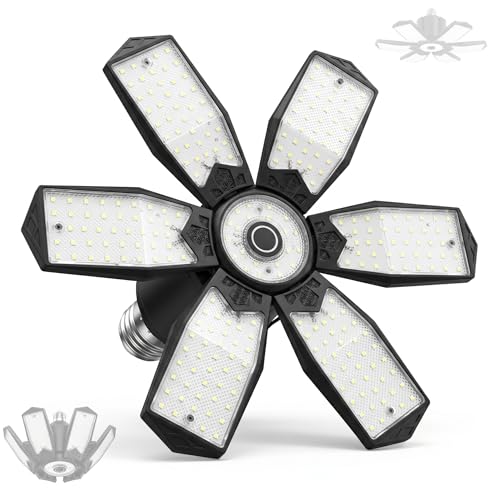
Upgrading to high-output directional fixtures introduces an intermediate investment tier driven by specialized mechanical construction. For example, the AYSEMO 150W LED Garage Lights design incorporates multi-panel aluminum leaf structures that can be manually angled to direct illumination across workshops, basements, or equipment bays. The inclusion of multiple deformable panels, heavy-duty stamped heatsinks, and dozens of high-density surface-mount diodes raises manufacturing and retail acquisition costs above standard domestic bulbs. Buyers investing in these heavy-duty screw-in units exchange a higher initial purchase price for expansive area coverage and high lumen density without requiring dedicated fixture hardwiring.
Specialized linear formats and targeted botanical luminaires occupy the higher initial acquisition tiers. Dedicated fixtures such as T5 high-output fluorescent lighting options and modern solid-state horticultural strips feature specialized phosphor coatings, moisture-resistant enclosures, and precision spectral tuning. These technical features require premium manufacturing standards and rigorous quality assurance to withstand damp indoor growing environments and continuous daily cycles. While these specialized lamps command a higher upfront purchase budget than general household globes, their targeted spectral emission prevents photosynthetic photon waste and promotes vigorous plant biomass.
The True Expense: Calculating Kilowatt-Hour Operational Costs
Electrical consumption over the operating life of a lighting fixture routinely dwarfs the initial retail shelf purchase price. To determine the ongoing cost of running any bulb, you must calculate its energy consumption by multiplying the true wall wattage draw by the daily run hours. Dividing that product by one thousand yields the total kilowatt-hours consumed during a single photoperiod. Multiplying this energy figure by your local utility provider rate reveals the exact recurring cost required to keep the lamp energized.
Operating hours create drastic differences in cumulative electricity expenses between living areas and indoor cultivation environments. A residential dining room bulb might operate for only three hours each evening, resulting in negligible monthly energy usage regardless of fixture efficiency. In contrast, an indoor garden lamp illuminating vegetative foliage often runs continuously for sixteen to eighteen hours per photoperiod across several consecutive months. Under these prolonged duty cycles, a fixture drawing significant electrical power can accumulate substantial utility charges that quickly overtake the original purchase price of the hardware.
Energy efficiency differences between legacy lighting technologies and modern solid-state diodes dramatically alter these recurring operational tallies. Older incandescent or halogen lamps convert roughly ninety percent of incoming electrical energy into radiant heat rather than visible light. High-efficiency light emitting diodes produce equivalent or greater luminous output while consuming a mere fraction of the wall wattage. Upgrading inefficient incandescent or legacy high-intensity discharge bulbs to efficient diodes significantly curtails ongoing monthly electric bills, allowing the hardware to pay for itself over extended use.
Efficiency Metrics: Lumens, PPFD, and Diode Efficacy
Evaluating the true value of a lighting product requires looking beyond simple wattage ratings to examine luminous efficacy metrics. Lumens measure total visible light output calibrated strictly to the human eye, indicating how brightly a bulb illuminates an interior workspace. For residential tasks and workshop utility, dividing total rated lumens by true power draw gives the lumens-per-watt efficiency rating of the fixture. Higher efficacy ratings indicate that the bulb produces generous visual clarity without drawing unnecessary electrical current from your breaker panel.
Horticultural applications rely on an entirely different set of photobiological metrics that determine photosynthetic efficiency. Plants do not process illumination according to human visual brightness, rendering standard lumen ratings largely irrelevant for indoor botanical cultivation. Horticultural lighting effectiveness depends instead on photosynthetic photon flux density delivered across the canopy. Assessing photosynthetic photon efficacy helps indoor growers evaluate whether a specialized lamp converts electricity into plant-usable photons efficiently enough to justify its equipment expense.
High-efficiency diodes feature advanced semiconductor architecture that extracts maximum photon output from every watt of electrical power. Premium diode binning ensures uniform color consistency, superior thermal tolerance, and lower forward voltage drop during extended illumination cycles. Although fixtures utilizing lower-grade diodes cost less initially on retail shelves, their reduced photon conversion rates require higher wall wattage to achieve equivalent illumination. Investing in fixtures built with high-efficacy diodes reduces lifetime kilowatt-hour consumption, providing measurable long-term financial savings for high-duty-cycle setups.
Thermal Dissipation and Driver Longevity Impact on Replacement Cycles
Operating temperature is the single greatest environmental factor governing the service lifespan and replacement cost of modern lighting. Solid-state diodes and internal electronic power supplies degrade rapidly when subjected to sustained internal heat accumulation. Quality fixtures utilize thick extruded or die-cast aluminum heat spreaders to conduct thermal energy away from delicate semiconductor junctions. Without robust passive heatsink cooling, internal diode temperatures rise, causing phosphor breakdown, accelerated photon decay, and premature fixture failure that forces expensive early replacement.
The electronic power supply or driver represents another critical component that directly influences the lifetime economics of any bulb. Lower-cost utility lamps often incorporate inexpensive capacitive drop power supplies housed directly inside plastic screw-in bases. These compact power supplies lack isolated thermal channels, exposing electrolytic smoothing capacitors to continuous heat radiation from the adjacent diode boards. When these sensitive capacitors dry out from thermal stress, the entire lamp flickers, dims, or fails completely, negating any initial savings achieved by purchasing a budget model.
Well-engineered multi-panel units combat thermal stress through distributed physical architecture and passive airflow convection. Fixtures featuring separate aluminum leaf wings allow ambient air to circulate freely around each diode array, maintaining low junction temperatures during continuous operation. This mechanical cooling capability extends the usable service life of both the diodes and the integrated driver circuitry toward tens of thousands of operating hours. Preserving consistent operating output over multiple years eliminates recurring bulb replacement expenses and minimizes maintenance labor in hard-to-reach ceiling installations.
Household Lighting vs. Specialized Horticultural Fixture Economics
Beginner indoor growers often wonder whether inexpensive domestic screw-in bulbs can substitute for dedicated horticultural grow lights. Standard residential lamps emphasize human comfort with broad warm-white or cool-white spectral emissions that lack concentrated deep red or far-red wavelengths. While household bulbs can support low-light foliage plants or early seedling emergence, their lower photon intensity requires hanging them extremely close to foliage. As plants expand into vigorous vegetative growth, ordinary domestic bulbs struggle to provide sufficient light intensity, leading to pale foliage and weak, stretching stems.
Dedicated horticultural systems balance spectral wavelengths across the photosynthetic spectrum to drive robust vegetative and floral development. Advanced setups such as vertical grow towers with integrated lights provide uniform vertical coverage tailored to dense multi-tiered plant canopies. These specialized systems command higher upfront capital investments because they integrate dedicated mounting channels, moisture-resistant wiring, and optically calibrated diodes. The enhanced biomass yield and accelerated growth rates achieved under targeted spectrums provide clear economic returns that general utility bulbs cannot match.
Utility bulbs modified for botanical growth also suffer from rapid intensity drop-off as distance from the light source increases. Standard domestic screw-in globes scatter light in wide spherical patterns, dispersing precious photons away from the canopy onto surrounding walls and floors. Specialized plant luminaires utilize directional diode arrays and secondary beam-shaping optics to project photons straight downward into the foliage. This focused photon delivery maximizes canopy absorption per watt consumed, ensuring that the electrical power you pay for directly supports active plant metabolism.
Hidden Expenses: Socket Compatibility, Ballasts, and Circuit Loads
Calculating total lighting costs requires accounting for socket compatibility and fixture conversion requirements. Screw-in units designed with standard medium E26 or mogul E39 bases install directly into existing domestic porcelain sockets without secondary adapters. In contrast, commercial linear fixtures and legacy fluorescent tubes frequently require dedicated ballasts, tombstone connectors, and specialized suspension hardware. When upgrading an existing fluorescent troffer to linear solid-state diodes, electricians often charge labor to perform a ballast-bypass wiring procedure, adding unexpected installation fees to the project.
Electrical circuit limitations present another hidden financial consideration when outfitting workshops or dedicated indoor growing rooms. Installing multiple high-wattage lighting units on a single shared household branch circuit can rapidly approach standard breaker amperage limits. Standard domestic breakers rated for fifteen or twenty amperes safely sustain continuous lighting loads only up to eighty percent of their maximum rating. Exceeding continuous branch thresholds requires hiring a licensed professional to install a dedicated electrical line, dramatically increasing total project setup expenses.
Thermal output from multiple lighting fixtures also impacts surrounding environmental conditioning and climate control costs. While high-efficiency diodes run substantially cooler than traditional incandescent or metal halide lamps, hundreds of watts of solid-state lighting still generate ambient heat. In enclosed grow tents or small utility workshops, this accumulated thermal energy must be evacuated using exhaust fans or dedicated air conditioning. Factoring auxiliary ventilation power and ducting components into your preliminary budget prevents unexpected cost overruns after your lighting hardware arrives.
Maximizing Fixture Lifespan Through Environmental and Operating Controls
Implementing practical maintenance protocols preserves fixture efficiency and defers replacement purchases for several years. Airborne dust, moisture, and foliar spray residues gradually coat optical surfaces, reducing transmitted light output by measurable margins. When dirt insulates external aluminum heatsink fins, internal operating temperatures climb, accelerating diode decay and stressing driver electronics. Periodically wiping optical lenses and vacuuming cooling fins with the power disconnected maintains proper thermal dissipation and restores peak photon delivery without costly equipment upgrades.
Automating photoperiod schedules with reliable digital timers or environmental controllers protects lighting hardware from voltage irregularities. Manual switching often leads to erratic run times, excessive heat cycles, and unintentional photoperiod disruptions that stress growing plants. Modern digital controllers ensure precise on-and-off cycling while preventing sudden inrush current spikes that can damage sensitive driver circuitry. By stabilizing daily operating cycles, automated controls extend the functional working life of internal power supplies and reduce the risk of premature diode burnout.
Providing adequate ambient ventilation around fixture housings is equally vital for preserving hardware investments. Mounting high-output screw-in units or multi-panel shop lights inside totally enclosed, unvented ceiling globes traps convective heat around the base components. This trapped heat drastically accelerates capacitor degradation, often causing a bulb rated for thousands of hours to fail within several months. Ensuring uninhibited airflow around heatsink fins keeps operating temperatures within safe manufacturer tolerances, protecting your equipment investment over its intended working lifespan.
Final Cost-to-Value Assessment for Everyday and Botanical Lighting
Determining whether a specific lighting unit provides genuine value requires weighing initial purchase pricing against cumulative performance benefits. An inexpensive utility globe is perfectly adequate for occasional residential illumination where annual run hours remain low. However, spaces requiring intense, prolonged illumination demand heavy-duty components with proven thermal management and high photon efficiency. The reduced energy consumption and prolonged service life of quality hardware consistently generate lower total ownership costs than continually replacing cheap, inefficient alternatives.
Matching your hardware selection to your exact space dimensions and operational goals prevents both under-lighting and wasteful overspending. Calculating true wall wattage, estimating daily photoperiod hours, and confirming thermal clearance gives you a realistic projection of ongoing lighting expenses before committing funds. Thoughtful hardware planning ensures you achieve bright, reliable illumination for workshops, living rooms, or indoor gardens while maintaining predictable, manageable utility bills. By focusing on electrical efficiency and build quality rather than just shelf purchase tags, you secure lasting lighting value for years to come.


Write Your Review
No reviews yet. Be the first to share your experience!