


Establishing a resilient home lawn requires working in harmony with seasonal growth cycles rather than fighting against peak summer heat or winter dormancy. Knowing when is best time to plant fescue grass seed provides cool-season cultivars with the precise environmental conditions needed for deep root development and dense foliage. Cool-season grasses like turf-type tall fescue and fine fescue establish best when soil temperatures hover between 50 and 65 degrees Fahrenheit. Sowing seed during this biological window prevents severe weed competition and allows tender roots to anchor before harsh winter frosts arrive.
Homeowners aiming for full seasonal lawn renovation often benefit from selecting a high-performing cool-season grass seed mixture tailored to their specific sun exposure and soil conditions. Proper timing also ensures that essential moisture remains in the top layer of soil without evaporating instantly under scorching summer sun. Understanding these seasonal triggers helps avoid patchy emergence, wasted seed investment, and recurring seedling disease. The following guide and product overview detail everything required to schedule planting effectively for lasting turf resilience.

Pros
- Requires very little mowing and no routine fertilization after establishment.
- Chemical-free and organic, so it's safe for families, pets, and the environment.
- Drought-tolerant once established, reducing water bills and maintenance.
- Shade-tolerant, performing well in partial sun to full shade in cooler climates.
- Supports pollinators like bees and butterflies with clover and wildflowers.
Cons
- Best suited for USDA zones 3-7 (per features) but labeled zones 6-9 on specs – check your zone before buying.
- Fine fescue lawns are not ideal for high-traffic areas; they can wear down with heavy foot or pet activity.
- Requires consistent moisture during the first 1-2 weeks for germination, which might be challenging in dry spells.
The Earthwise EcoSeed No Mow Lawn Seed Mix is a fine fescue blend designed for homeowners who want a sustainable, low-maintenance lawn without sacrificing aesthetics. This 5-pound bag covers up to 1,000 square feet and is ideal for small to medium yards, especially those with partial shade or cooler climates. The mix includes creeping red fescue, Chewings fescue, and sheep fescue, along with clover and wildflowers to support pollinators. It's marketed as organic, non-GMO, and free of harmful chemicals, making it a safe choice for families and pets.
In practice, the standout feature is how little upkeep it demands. Once established, this lawn requires minimal mowing (often just once or twice a season) and no synthetic fertilizers or pesticides. The deep-rooted fine fescues are naturally drought-tolerant, so you can cut back on watering after the first growing season. The shade tolerance is a real plus for yards with tree cover or north-facing slopes where traditional grass struggles. Germination typically takes 7 to 14 days with consistent moisture, and the seed comes with an organic tackifier (Lock In Your Lawn) to prevent washout on slopes.
Build quality is solid – the seed is fresh and free from weed seeds or fillers. The packaging is a simple plastic bag with clear planting instructions. However, there's a notable discrepancy in the USDA zone information: the features list says zones 3-7, while the specifications say zones 6-9. This could confuse buyers, so double-check your local climate before ordering. Also, fine fescue lawns are not designed for heavy foot traffic – they're best for ornamental or low-use areas. If you have active kids or dogs running around, consider a more durable grass blend.
Another consideration: the initial establishment requires careful watering. If you miss a few days during the germination window, you might see patchy results. Once established, though, the lawn is remarkably resilient. The pollinator-friendly aspect is a nice bonus – clover and wildflowers attract bees and butterflies, adding ecological value.
Overall, the Earthwise EcoSeed No Mow Lawn Seed Mix delivers on its promise of a low-maintenance, eco-friendly lawn. It's best for homeowners in cooler, temperate zones who want a green space that looks natural and supports wildlife without the hassle of traditional grass. Just be mindful of the zone confusion and traffic limitations. For the price, it's a solid investment for a sustainable lawn.

Pros
- Low maintenance with minimal watering and mowing once established.
- Organic and chemical-free, safe for families and pets.
- Supports pollinators like bees and butterflies with clover blooms.
- Drought tolerant and improves soil health through nitrogen fixation.
- Quick germination in 2-5 weeks with proper watering.
Cons
- Some users report inconsistent height control with some fescue growing over 10 inches.
- Requires careful watering and soil prep; a few customers experienced no germination.
- Best performance is limited to zones 6-9 and may struggle in hotter climates without shade.
The Earthwise Low Grow No Mow Grass Seed Mix is a thoughtful blend of clover and fine fescues designed for homeowners who want a greener, easier lawn. It aims to replace traditional grass with a low-maintenance, drought-tolerant alternative that needs less water, no chemicals, and only occasional mowing. This mix is perfect for eco-conscious families, pet owners, and anyone looking to support local pollinators while reducing yard work.
In real-world use, this seed mix delivers on its promise of a lush, soft lawn that stays green with minimal care. Many customers report quick germination within a few days for clover and a couple of weeks for grass, especially with regular watering. The blend is well-suited for zones 6-9 and thrives in full sun or part shade. Some users noted that the grass can grow taller than the advertised 7 inches, especially in rich soil, but regular mowing keeps it tidy. The clover component adds a nice pop of green and attracts bees, which is a plus for pollinator gardens.
The organic, non-GMO seed is free from pesticides and synthetic fertilizers, making it safe for kids and pets to play on. The included Seed-Tac Organic Tackifier helps prevent seed washout on slopes, boosting germination rates. However, a few customers experienced no germination at all, likely due to inconsistent watering or poor soil contact. The mix also requires patience, as full coverage can take one to two seasons to develop.
Drawbacks are worth noting. The height claim may be optimistic, as some fescue varieties in the mix can exceed 10 inches if left unmowed. Additionally, the blend is not ideal for all climates, performing best in cooler zones with adequate moisture. The 1/2 lb bag covers only 200 sq ft for bare soil, which might be small for larger lawns.
Overall, the Earthwise Low Grow No Mow Grass Seed Mix is a solid choice for those seeking a sustainable, low-maintenance lawn. It balances ease of care with environmental benefits, though results depend on proper planting and local conditions. If you want to reduce your lawn's water and chemical footprint, this mix is worth trying.

Pros
- High purity with 99.9% weed free guarantee ensures clean establishment.
- Uncoated seed means you get more actual seed per pound, no coating waste.
- Performs well in both sunny and shaded areas, offering flexibility.
- Drought-tolerant and durable, suitable for high-traffic lawns.
- Large coverage from a single 50 lb bag, cost-effective for big projects.
Cons
- Some users reported slower germination, taking closer to the full 14 days.
- A few reviewers experienced weed issues despite the 99.9% claim, though this may vary by batch.
- Higher seeding rate needed for new lawns can make the bag go faster than expected.
The Scotts Professional Turfgrass Seed Tall Fescue Mix is a solid choice for anyone looking to establish or overseed a lawn with high-quality fescue. Designed for professionals but accessible to homeowners, this uncoated mix promises 99.9% weed free content and adapts well to both sunny and partially shaded areas. With a medium to high drought resistance and high durability, it's built to handle real-world conditions.
In practice, the seed generally germinates within 7 to 14 days, though some users found it leaned toward the slower end. Those who prepped their soil well and watered consistently saw good results, especially in zones with clay or rocky soil. Positive reviews highlight rich color, thick growth, and excellent performance even in challenging climates like Alaska. However, a minority reported weed problems or uneven filling, which may be due to batch variation or site conditions.
The product is uncoated, which means you're not paying for inert coating material. This is a plus for seed-to-value ratio, but it also means the seed is more vulnerable to drying out if not watered diligently. The coverage rates are straightforward: 8 lbs per 1,000 sq ft for new lawns and 4 lbs per 1,000 sq ft for overseeding. A single 50 lb bag thus goes a long way, covering up to 12,500 square feet for overseeding.
Drawbacks to consider: germination speed can be inconsistent, and a few users reported invasive weeds overtaking their lawn after planting this seed. While Scotts markets the mix as 99.9% weed free, no seed is perfect, and environmental factors play a role. Also, the price point is higher than many consumer-grade seeds, but the professional-level results can justify the investment for serious lawn enthusiasts.
Overall, the Scotts Professional Tall Fescue Mix is a reliable, high-performing seed for those willing to put in the prep work and patience. It delivers a lush, durable lawn in most conditions, making it a strong contender for overseeding or new installations. Just be prepared to water regularly and consider a starter fertilizer to maximize germination.

Pros
- Excellent heat and drought tolerance; stays green in extreme heat.
- Self-repairing ability reduces maintenance and overseeding.
- OptiGrowth coating for better germination and faster establishment.
- Good shade tolerance for a fescue blend.
- Faster germination reported by many users.
Cons
- Inconsistent germination reported by some users; results may depend on planting timing and soil preparation.
- Requires consistent watering during establishment despite drought tolerance.
- Not a no-mow option; mowing required at 3-4 inches.
The Outsidepride Combat Extreme Southern Zone grass seed mix is a thoughtfully blended turf-type tall fescue and hybrid bluegrass designed specifically for the challenging climates of USDA zones 8 through 10. It's aimed at homeowners in the southern United States who want a lush, green lawn without the constant watering and maintenance typical of Bermuda or Zoysia. The inclusion of SPF 30 hybrid bluegrass (a cross of Kentucky and Texas bluegrass) adds heat tolerance and a finer texture to the lawn.
In practice, this blend has proven resilient. A reviewer in Tucson, Arizona reported that after planting last October, the grass stayed fully green through 110+ degree stretches and self-repaired moderately. Another user in South Carolina praised its thick, green appearance while neighbors' lawns turned brown. However, not everyone had success. Some users saw little to no germination, possibly due to planting in midsummer or insufficient soil preparation. Proper timing (spring or fall when soil temps reach 55F) and consistent moisture during establishment are key to getting good results.
The OptiGrowth coating is a standout feature. It includes moisture-retaining Aquatek absorbent, essential nutrients, and Elko kelp for stronger roots. This coating improves soil contact and speeds up germination. The blend's deep root system reduces water needs and mowing frequency, while tillering allows the grass to fill in bare spots naturally. For southern lawns, this means less reliance on frequent reseeding and more time enjoying a green lawn.
Some drawbacks to consider. The seed is not a miracle worker; it requires good soil preparation and consistent watering in the first few weeks. A few users found it didn't germinate at all, though others had excellent results. Also, while drought tolerant, it's not a xeriscape option - you'll still need to water during dry spells. The 5-pound bag is a good starting size for small to medium lawns, but larger areas may require multiple bags.
Overall, the Outsidepride Combat Extreme Southern Zone mix is a solid choice for southern homeowners who want a green lawn through summer without the dormant period of warm-season grasses. It offers good heat tolerance, self-repair, and attractive color. If you're willing to follow planting instructions carefully and give it proper care, this seed can deliver a beautiful lawn. For those in zones 8-10 seeking an alternative to Bermuda or Zoysia, it's worth trying.
Pros
- Excellent drought tolerance once established
- Quick germination with proper soil contact and watering
- Affordable price point for the coverage area
- Handles hot summers and heavy rain without disease issues
- Soft, attractive grass that blends with existing lawns
Cons
- Requires meticulous soil prep and frequent watering for best results; simply scattering on bare soil may fail
- Not suitable for full shade areas; needs at least 4 hours of sun daily
- Some users reported inconsistent germination on large bare patches without top dressing or straw cover
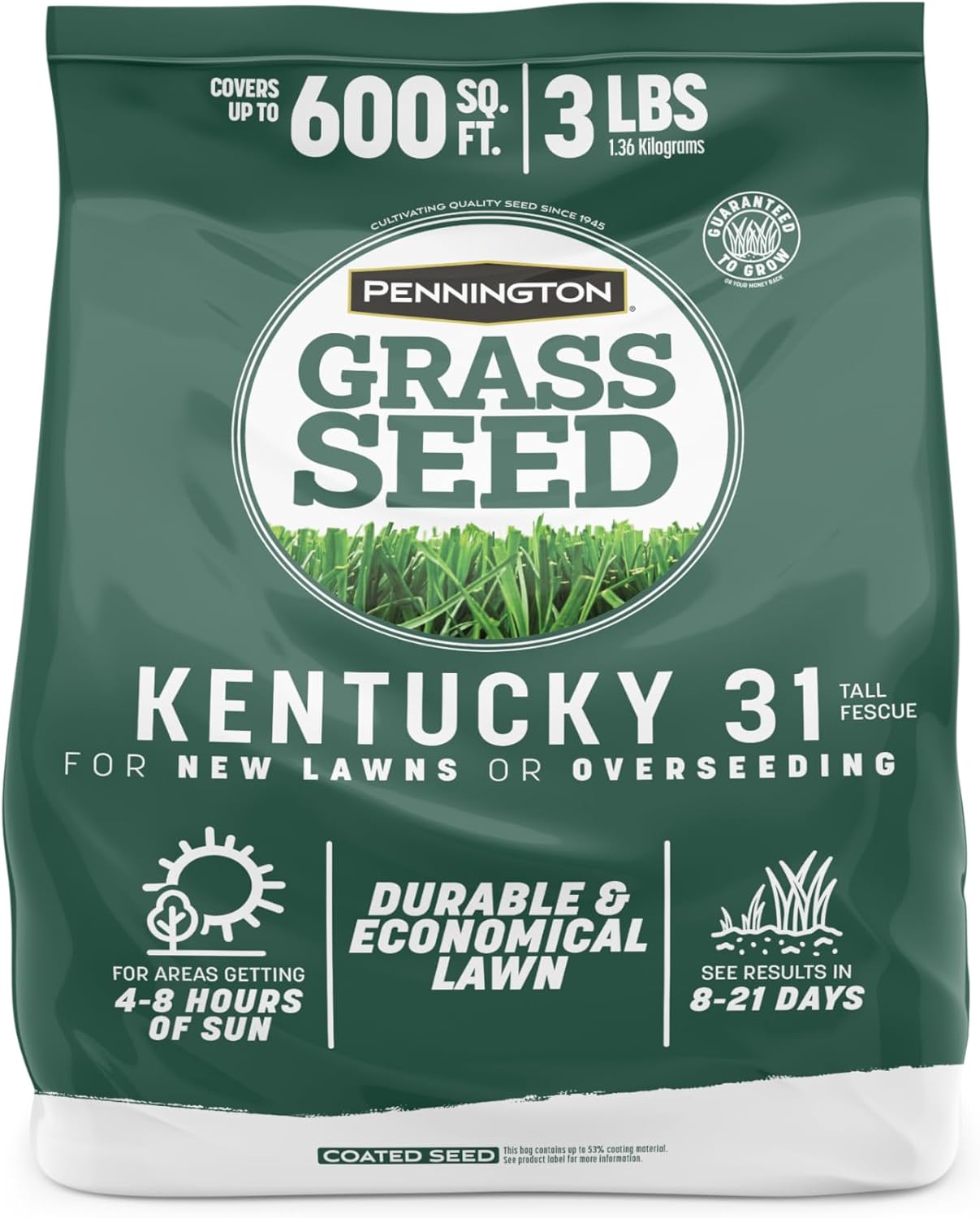
Pennington’s Kentucky 31 Tall Fescue has been a staple in the grass seed industry for decades, and this 3-pound bag brings that heritage to your lawn at an affordable price. It’s designed for homeowners who want a tough, low-maintenance turf that can handle hot summers, heavy rain, and a bit of foot traffic. The Penkoted coating on each seed helps protect it during handling and gives germination a boost, which is a nice touch for DIY lawn care.
Real-world performance from users backs up the claims. Many report seeing green shoots within 8 to 21 days, especially when the seeds are gently worked into the soil and kept consistently moist. One reviewer in North Carolina had great results patching bare spots in clay soil during fall, noting the grass came up soft, green, and wanted. Another in Florida used it to overseed their existing lawn and loved how quickly it filled in, though they cautioned that full-sun summer days might require supplemental watering. The seed seems to perform best in small areas with good soil contact; larger bare patches may need a light top dressing or straw cover to keep the seeds moist.
Build quality is solid for a grass seed. Pennington works directly with growers, so you’re getting fresh seed with a germination rate that’s typically around 80% or higher. The 3-pound bag covers up to 600 square feet for overseeding or about 415 for a new lawn, which is decent for small to medium projects. The only real design downside is that the bag doesn’t include a spreader, but that’s standard for this type of product.
Drawbacks? The biggest one is that this grass demands proper soil prep and watering. If you just toss it on dirt without raking it in or covering it, you’ll likely be disappointed. Also, it’s a cool-season grass, so it won’t thrive in full shade or extreme southern climates without extra care. A few reviews mentioned that large bare spots didn’t fill in as quickly as hoped, but that’s more about technique than the seed itself. One reviewer flagged a label issue (test date typo) but Pennington’s customer service quickly clarified it, which shows decent support.
Verdict: If you have a lawn that gets 4-8 hours of sun and you’re willing to water regularly and prep the soil, Pennington Kentucky 31 is a reliable, economical choice. It’s not a miracle seed, but it delivers on its promises for a durable, drought-resistant lawn. Skip it if you’re looking for a no-water, toss-and-go solution.
Brand: Pennington
Product Name: 100% Kentucky 31 Tall Fescue Penkoted Grass Seed
Weight: 3 lb (48 oz)
Coverage: Up to 600 sq ft for overseeding; approximately 415 sq ft for new lawn
Sunlight: 4-8 hours of sun (full sun to medium shade)
Expected Blooming Period: Spring to Summer
Best Planting Time: Early spring or early fall
Germination Time: 8-21 days
Soil Type: Clay soil
Special Feature: Penkoted coating for improved germination
ASIN: B0B5M11GL5

Pros
- Very affordable for the coverage area
- Proven heat and drought tolerance
- Stands up well to foot traffic and pets
- Germinates quickly under proper conditions
- Versatile for full sun to partial shade
Cons
- Needs thorough soil preparation and consistent moisture for best germination
- Can be vulnerable to birds if seed isn't covered or raked in
- May require extra watering during hot, dry spells to establish
The Pennington Kentucky 31 Tall Fescue is a classic cool-season grass seed that has earned its reputation for durability and low maintenance. This 7-pound bag is designed for homeowners who want a tough, heat-tolerant lawn that can handle both sun and moderate shade. It's a great fit for those in transitional or northern climates who need grass that survives hot summers and comes back strong in the fall.
One of the standout features is the Penkoted coating, which helps protect the seed during germination and gives it a better start. In real-world use, reviewers report seeing results within 8 to 21 days, especially when the seed is worked into loose soil and kept moist. The grass develops thick, sturdy blades that stand up to foot traffic and dry spells better than many other varieties. Many users appreciate that it covers up to 1,400 square feet, making it a cost-effective option for large lawns or overseeding projects.
Build quality is solid for a grass seed product. The bag is sturdy plastic with clear instructions on coverage and planting depth. A few buyers noted that the seed label had a questionable test date, but the manufacturer quickly clarified it was a typo, and the seed performed normally once planted. It's also worth mentioning that this fescue has a lighter green color compared to some hybrid blends, but that's a natural trait of the variety, not a defect.
Drawbacks are mainly tied to planting technique. The seed requires good soil contact to germinate well. Simply scattering it on hard ground often leads to poor results. Birds can also be a nuisance if the seed isn't covered with a thin layer of soil or straw. Additionally, in very hot or dry weather, you'll need to water consistently to keep the seedlings alive until they establish deeper roots. One user in Florida had success by following instructions carefully, while another in North Carolina saw strong growth after tilling the soil.
Overall, the Pennington Kentucky 31 Tall Fescue is a reliable, straightforward grass seed that delivers on its promises when you put in a little prep work. It's not the flashiest or fastest-growing option, but for durability, drought resistance, and value, it's a solid choice for any lawn that gets at least 4 hours of sun a day. If you're willing to take the time to prepare the soil and keep it watered during the first few weeks, you'll be rewarded with a tough, long-lasting turf.

Pros
- Fast germination and growth, with many reviewers seeing sprouts in about a week
- All-in-one convenience saves time and effort compared to buying seed and fertilizer separately
- Effective for patching bare spots and overseeding large problem areas
- Can handle some shade, though best in full sun; a few users saw decent results in partial shade
- Built-in fertilizer helps establish deeper roots and greener grass
Cons
- Requires diligent watering (twice daily recommended) to achieve optimal growth
- Not ideal for heavy shade areas; some spots may fail to germinate
- Mixed germination results in a small number of reviews, possibly due to temperature or watering conditions
The Scotts Turf Builder Rapid Grass Tall Fescue Mix is a convenient all-in-one solution for homeowners looking to revitalize their lawn. This product combines tall fescue grass seed with a fertilizer that feeds the grass as it grows. It is perfect for both starting a new lawn from scratch and overseeding an existing tall fescue lawn to fill in bare patches. The mix is designed to grow 2X faster than seed alone when applied at the new lawn rate with proper care, making it a popular choice for quick results.
Real-world performance matches the promise for most users. Many reviews highlight visible sprouts within a week and a thick, green lawn after two to three weeks. One reviewer noted that even with direct afternoon sun and inconsistent watering, the grass grew healthy and thick. Another user in Southern California praised its reliability in both winter and summer heat. However, a minority of customers reported slow or poor germination, often in areas with heavy shade or when watering was not consistent. The product performs best in full sun and with regular watering twice a day.
Application is straightforward: spread the mix using a Scotts spreader, water thoroughly twice daily, and avoid using weed control products until the grass is established. The 5.6 lb. bag covers 615 sq. ft. for new lawns and 1,845 sq. ft. for overseeding, which is generous. The mix is GMO free and works well when applied in spring or fall with temperatures between 60 and 80°F.
A few drawbacks are worth noting. The biggest is the need for consistent watering, which can be a challenge during dry spells. Some users in shadier spots saw less germination, so it's not a one-size-fits-all solution. Also, a handful of reviews mentioned no germination at all despite following instructions. These cases seem to be exceptions but are worth considering if your lawn has special conditions.
Overall, the Scotts Turf Builder Rapid Grass Tall Fescue Mix is a solid, easy-to-use option for anyone who wants to see grass fast. The built-in fertilizer saves a step, and the germination rate is high when conditions are right. For best results, pair it with a proper watering schedule and choose a sunny spot. It's not perfect for all situations, but for typical tall fescue lawns, it delivers on its promises.

Pros
- Excellent for dry, hot regions and high elevations
- Endophyte-free ensures livestock safety
- Micro-Boost improves seed emergence and root strength
- Covers a quarter acre per bag, good value
- Blend of multiple grass types offers balanced nutrition
Cons
- Only 0 reviews so far, limited user feedback
- May require full sun and proper soil preparation for best results
- Not suitable for very wet or humid climates
X-Seed's Pasture Land Dry-Land Forage Seed Mixture is a premium blend designed for livestock owners in hot, dry climates. Formulated by DLF, this 7-pound bag contains tall fescue, orchard grass, and tetraploid annual ryegrass, all endophyte-free for safe grazing. It's ideal for over-seeding tired pastures or starting new ones in areas up to 8,000 feet elevation.
The standout feature is Micro-Boost technology, which enhances germination and root development. This means faster establishment and stronger plants that can withstand drought and heavy grazing. The endophyte-free formula eliminates toxins that can harm livestock, making it a healthier choice for your animals.
In real-world conditions, this mix performs well under stress. It tolerates both cold winters and hot summers, providing consistent forage year-round. The blend is designed for full sun and covers a quarter acre per bag. While there are no customer reviews yet, the specifications suggest a reliable product for dry regions.
One potential drawback is that it requires full sun and proper soil preparation to thrive. It may not be suitable for wet or humid climates. Additionally, the lack of user feedback means you're relying on the manufacturer's claims. However, X-Seed has a solid reputation in seed innovation.
Overall, if you manage livestock in a dry area and need a nutritious, endophyte-free pasture mix, the Pasture Land Dry-Land blend is a solid investment. The Micro-Boost feature gives it an edge in establishment, and the variety of grasses ensures balanced nutrition.
Brand: X-Seed
Item Weight: 7.11 pounds
Product Dimensions: 32 x 20 x 4 inches
Coverage: 1/4 acre per bag
Material Feature: GMO Free
Special Feature: Drought Tolerant
Expected Blooming Period: Spring to Fall
Unit Count: 112.0 Ounce
Determining the Optimal Planting Window for Fescue Grass Seed
Cool-season turfgrasses operate on a biological schedule that favors warm soil combined with cooling ambient air. The late summer into early autumn window represents the primary window for sowing tall and fine fescue blends across most temperate zones. Sowing during this period takes advantage of soil that has stored solar heat throughout the summer, accelerating metabolic activity inside the seed embryo. Secondary opportunities exist during early spring, though growers must navigate cold soil and aggressive summer annual weed pressure.
The Biological Advantages of Early Autumn Seeding
Early autumn seeding aligns with the natural reproductive cycle of cool-season grass varieties. When soil temperatures remain between 50 and 65 degrees Fahrenheit, fescue seed germinates rapidly, often emerging within seven to fourteen days under consistent moisture. Cooler daytime air temperatures between 60 and 75 degrees Fahrenheit reduce heat-induced transpiration stress on newly emerged seedlings. This temperature differential encourages vigorous root architecture without forcing excessive top-growth that drains energy reserves.
Autumn also presents significantly lower competition from aggressive annual weeds such as crabgrass, foxtail, and goosegrass. Most summer annual weed seeds enter dormancy or reach the end of their life cycle as nighttime temperatures begin to drop. Fescue seedlings that establish during September and October develop dense root crowns without fighting invasive weed canopies for light and nutrients. This structural head start allows the turfgrass to survive winter freezing and emerge rapidly in spring.
Underground root development continues well into late autumn even after top blade growth halts. Soil temperatures drop much more slowly than ambient air temperatures, allowing the root system to expand deep into the soil profile. This extended subterranean root expansion establishes drought resistance for the upcoming summer. By the time high temperatures arrive the following June, fall-planted fescue already possesses mature taproots capable of pulling moisture from deep subsoil layers.
Spring Planting Realities and Temperature Thresholds
Spring planting offers a viable alternative for property owners who missed the autumn window or need to repair winter bare spots. The critical challenge in spring revolves around waiting for soil to reach a sustained 50 degrees Fahrenheit while racing against incoming summer heat. In most regions, this window opens between mid-March and late April, depending on local latitude and thaw patterns. Seeding too early into cold, wet mud leads to seed rot, while seeding too late leaves shallow roots vulnerable to summer sun.
Weed management requires careful planning when establishing fescue in the spring. Standard pre-emergent crabgrass preventers create a chemical barrier that stops all seeds from developing, including desirable tall fescue seedlings. Homeowners must either select seeding-safe pre-emergent active ingredients like mesotrione or delay standard weed control until new turf has been mowed at least three times. Skipping weed protection entirely often results in heavy crabgrass infestations that choke out delicate grass shoots by mid-summer.
Spring-sown fescue grass demands substantial irrigation support throughout its first summer. Because the root system has only experienced a few months of development, it lacks the depth of an autumn-established turf stand. Hot summer dry spells can cause rapid wilt and dormancy in first-year spring lawns if irrigation is not maintained. Gardeners opting for spring establishment must commit to regular moisture monitoring through July and August to prevent widespread seedling mortality.
Measuring Soil Temperature Versus Air Temperature
Air temperature reports from local weather broadcasts provide an incomplete picture for lawn seeding decisions. Soil possesses high thermal mass, meaning ground temperatures change much more slowly than fluctuating atmospheric conditions. A sudden 75-degree afternoon in early March does not indicate that ground soil has thawed sufficiently for seed germination. Conversely, crisp 55-degree autumn mornings often conceal ideal 65-degree soil temperatures that stimulate rapid fescue sprouting.
Using a dedicated soil probe thermometer eliminates guesswork when tracking regional planting windows. Insert the metal probe two to three inches into bare soil at the same time every morning for three consecutive days. The consistent average of these morning readings reflects the baseline temperature surrounding newly broadcast seed. Sowing when morning soil levels sit firmly between 50 and 65 degrees Fahrenheit ensures high germination percentages and uniform seedling emergence.
Regional microclimates across a residential property also create distinct temperature zones. North-facing yards or areas beneath dense evergreen canopies warm up significantly slower in spring and cool down faster in autumn. South-facing slopes absorb direct solar radiation, elevating soil temperatures several degrees above shaded zones. Evaluating these property microclimates ensures that seed is distributed when each specific area matches fescue germination thresholds.
Regional Timing Variations Across Climate Zones
Geography dictates exact calendar windows for cool-season turfgrass planting. Northern regions spanning USDA Plant Hardiness Zones 4 through 6 typically experience their ideal autumn planting window from mid-August through late September. In these cooler latitudes, waiting until late October risks hard frosts that freeze delicate seedlings before root cell membranes have hardened. Spring windows in the north generally open between mid-April and early May once soil thaws and drains.
The central Transition Zone, covering portions of USDA Zones 6 through 8, enjoys an extended autumn seeding calendar. Here, the optimal window generally stretches from early September through mid-October, with warm ground persisting late into the season. Transition zone summers are intensely hot, making tall fescue varieties with heat-tolerant genetics essential for survival. Homeowners exploring regional grass options can contrast these requirements with planting warm-season centipede grass, which thrives under opposite seasonal temperature curves.
Deep southern areas situated in Zones 8 through 10 present extreme heat challenges for cool-season grasses. Specialized seed mixtures combining turf-type tall fescues with hybrid Texas bluegrass varieties are formulated to expand heat durability in these southern margins. Autumn planting in these zones extends from October into early November to avoid lingering summer soil heat. Seeding during intense southern heat waves stresses cool-season embryos and promotes devastating fungal pathogens such as Pythium blight.
Fescue Variety Nuances: Cultivar Traits and Establishment Rates
Selecting the appropriate fescue species directly influences establishment speed and seasonal performance. Turf-Type Tall Fescues (TTTF) represent the modern standard for residential lawns, featuring fine leaf texture, deep rooting potential, and high wear tolerance. These varieties typically germinate within seven to fourteen days when moisture remains constant. Their bunch-forming habit produces a dense sod that tolerates both full sun and moderate partial shade in transition climates.
Fine fescue blends, which incorporate Creeping Red, Chewings, and Sheep fescues, serve a specialized role in low-input and shaded environments. Fine fescues germinate in seven to fourteen days and exhibit superior tolerance to low light beneath dense tree canopies where tall fescue struggles. They require less frequent mowing and thrive on lean, low-nitrogen fertility programs that would starve standard turfgrass. Their needle-like foliage forms a soft carpet but handles heavy foot traffic with less resilience than tall fescue.
Traditional varieties like Kentucky 31 Tall Fescue offer an economical, coarse-bladed option suited for utility pastures, roadsides, and sprawling acreage. Kentucky 31 germinates in eight to twenty-one days and demonstrates remarkable heat and drought tolerance under minimal maintenance. Its wider blade profile and lighter green color contrast sharply with modern dark-green dwarf turf-type cultivars. Property owners should avoid mixing coarse utility fescues into established dwarf lawns to prevent an irregular, clumpy visual texture.
Seed Coating Formulations and Pure Live Seed Considerations
Understanding the difference between raw uncoated seed and coated seed formulations prevents costly seeding rate miscalculations. Many commercial products include seed coatings composed of moisture-absorbent polymers, micronutrients, or systemic fungicide treatments. These coatings help the seed absorb moisture rapidly and protect delicate embryos from early damping-off disease. However, the physical coating material can account for up to fifty percent of the total bag weight.
Calculating Pure Live Seed (PLS) clarifies the actual volume of viable plant embryos entering the soil. PLS is calculated by multiplying the certified purity percentage by the tested germination percentage listed on the seed label. When using coated seed, gardeners must increase their total gross application rate per thousand square feet to ensure adequate plant density. Reviewing the certified analysis tag on every bag confirms germination test freshness, weed seed percentage, and inert coating mass.
Uncoated raw seed provides maximum seed count per pound, making it the preferred choice for bulk contractors and expansive acreage overseeding. Raw seed requires meticulous seedbed preparation and strict watering oversight because it lacks artificial moisture buffers. Conversely, coated seed offers an added safety cushion on sloped grades or exposed areas prone to rapid surface desiccation. Both formats deliver successful turf stands when applied at appropriate rates during favorable temperature windows.
Seedbed Preparation and Soil-to-Seed Contact
Proper soil preparation remains the single most important physical factor governing fescue seed germination success. Grass seeds scattered across a thick thatch layer or hard-packed clay struggle to push embryonic radicles into the ground. Core aeration relieves soil compaction and creates hundreds of miniature seedbed cavities that capture moisture and seed. Dethatching removes spongy organic debris that prevents seed from reaching mineral soil.
Achieving direct seed-to-soil contact ensures that moisture transfers efficiently from damp ground into the seed coat. Following established techniques on how to best plant seeds, growers should lightly rake or roll the seeded area to embed kernels roughly one-eighth to one-quarter inch deep. Seeds buried deeper than one-quarter inch often exhaust their internal energy stores before the green shoot breaches the surface. Uncovered surface seeds, meanwhile, risk drying out or washing away during sudden rain events.
Topdressing bare spots with a light quarter-inch layer of clean peat moss, fine compost, or specialized seed cover conserves vital surface humidity. This protective top layer shields the seedbed from direct sun exposure and minimizes seed movement from runoff. Straw can also be used on sloped terrain, provided it is clean and free of agricultural weed seeds. Ensuring every seed is anchored firmly against moist soil dramatically increases overall germination uniformity.
Moisture Management During the Critical Establishment Window
Consistent surface moisture controls seedling survival throughout the initial fourteen to twenty-one days after sowing. The germination process triggers irreversible cellular expansion once water penetrates the protective outer hull. If a swollen seed dries out even once before anchoring its primary root, the embryo perishes. Lawn owners must maintain consistent dampness in the top half-inch of soil without creating standing puddles or muddy erosion channels.
Irrigation routines should feature short, frequent watering sessions rather than infrequent deep soakings during the germination stage. Applying water for five to ten minutes, two to four times daily, keeps the seedbed continuously moist under drying winds. As seedlings emerge and reach one to two inches in height, irrigation frequency should be gradually reduced while run times increase. This deliberate transition trains tender root tips to reach deeper into the soil profile in search of subsurface moisture.
Excessive saturation poses just as much danger as severe dehydration during the early establishment phase. Over-watered soils suffocate root cells by displacing vital oxygen from subterranean pore spaces. Saturated, poorly draining ground also encourages fungal pathogens that trigger damping-off, causing healthy young shoots to collapse at soil level. Adjusting sprinkler schedules based on natural rainfall events prevents soggy ground while preserving crucial moisture levels.
Post-Germination Management: First Mowing and Long-Term Turf Vigor
Managing early turf growth requires patience before resuming normal lawn care routines. The initial mowing should take place only after new fescue shoots reach approximately three and a half to four inches in height. Mower blades must be sharpened to prevent tearing or uprooting young seedlings that possess tender root anchors. Set the mowing deck to cut no more than the top third of the blade, maintaining a finished height around three inches.
Fertility management should prioritize balanced starter nutrients rather than heavy doses of synthetic fast-release nitrogen. Starter fertilizers supply readily available phosphorus and potassium to encourage robust root branching and cellular wall strength. Excessive nitrogen applications on juvenile fescue force succulent, top-heavy growth that increases vulnerability to fungal leaf spot diseases. Once the lawn completes its first four to six weeks of growth, gentle maintenance feeding supports long-term density.
Restricting heavy foot traffic and pet activity allows juvenile fescue clumps to mature without physical soil shearing. Because most fescues possess a bunch-type growth habit, damaged young crowns cannot rapidly spread horizontal stolons to fill bare gaps. Providing several weeks of undisturbed growth ensures deep root anchoring and resilient crown formation. Aligning proper seasonal planting dates with disciplined cultural maintenance delivers a thick, verdant fescue lawn that endures environmental stress for seasons to come.


Write Your Review
No reviews yet. Be the first to share your experience!